Category Archives: Uncategorized

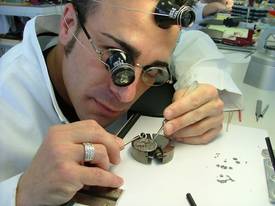
Anthrax’s Dan Spitz is now a master watchmaker

[Dude. -egg]

Sent to you via Google Reader

Anthrax’s Dan Spitz is now a master watchmaker

Hodinkee‘s John Reardon has a great profile on and interview with Dan Spitz, former Anthrax guitar hero who quit the music business to become a world-renowned, prize-winning watchmaker who hand-lathes his own replacement parts for antique watch restorations. Reardon quit his gig to spend more time with his family — he has twin boys who have autism — and to pursue his lifelong technical passions. He’s hand-built his own workbench!


Funny story, actually. I was working as a watchmaker in Geneva and thinking I would never go back to music when Dave Mustaine from Megadeth called me and said “Dude, what are you doing? Stop messing with watches. You need to come back and start writing music again. You are one of the creators of our genre, thrash metal. You need to stop tinkering around with these million dollar toys and get back to music.” This lecture led to the end of my solitary confinement as a watchmaker. I looked down the bench and saw another watchmaker working on a crazy watch but obviously also headbanging. I walked over to him and saw that he was blasting Slayer. He was working on a multiple fly-back, jump hour, chrono, perpetual calendar, moon phase, tourbillon and he’s blasting Slayer! I looked at him and thought, “That’s it, I’m done. I’m going back to music.” In the end, most people in Switzerland are blasting while working on watches, anything from Barbra Streisand to Slayer.

My grandfather was a watchmaker, and I grew up playing with junk movements and parts. It’s amazing to hear the story of someone so accomplished — especially in a second career begun as an adult.

Interview: Meet Dan Spitz, Anthrax Guitarist Turned Master Watchmaker

(via Kottke)


HOWTO protect yourself from ATM skimmers

HOWTO protect yourself from ATM skimmers:

Brian Krebs, who has written many excellent investigative pieces on ATM skimmers, spent several hours watching footage seized from hidden skimmer cameras, and has concluded that covering your hand while you enter your PIN really works in many cases — and that many people don’t bother to take this elementary step.

Some readers may thinking, “Wait a minute: Isn’t it more difficult to use both hands when you’re withdrawing cash from a drive-thru ATM while seated in your car?” Maybe. You might think, then, that it would be more common to see regular walk-up ATM users observing this simple security practice. But that’s not what I found after watching 90 minutes of footage from another ATM scam that was recently shared by a law enforcement source. In this attack, the fraudster installed an all-in-one skimmer, and none of the 19 customers caught on camera before the scheme was foiled made any effort to shield the PIN pad.

Krebs goes on to note that this doesn’t work in instances where the skimmer includes a compromised PIN pad, and it seems likely that if covering PINs became more routine that crooks would take up this technique more broadly. But for now, covering your PIN with your free hand is a free, effective means of protecting yourself from ATM skimmers.

A Handy Way to Foil ATM Skimmer Scams


Check out: Bad Lip Reading

Check out: Bad Lip Reading:
Bad Lip Reading is one of my favorite YouTube channels. Here’s their take on Twilight.

This is the first time I’ve seen them try to assemble a coherent narrative (of sorts) out of their re-dubs. Usually it’s silly non sequitur stuff like this hilarious Mitt Romney piece:

“I bought two zebras and tamed a parrot named Mr. Future.” I could watch this stuff all day.

Why SF movies make me insane

Why SF movies make me insane:
My latest Locus column is “Why Science Fiction Movies Drive Me Nuts,” in which I propose that the reason the science in sf movies is so awful is that they’re essentially operas about technology.

The reason that SF movies command such a titanic amount of attention and money from audiences is because they are brilliantly wrought spectacles. What they lack in depth and introspection, they make up for in polish and craftsmanship. Every costume is perfect. Not one polygon is out of place. An army of musicians, the greatest in the land, have picked up horns and stringed instruments by the orchestra-load and played precisely the right music to set the blood singing, written by genius composers and edited into the soundtrack by golden-eared engineers from the top of their trade. The product is perfectly turned out, and this perfection attracts the eye and captures the mind.

But although these spectacles look like movies, what they really are is opera – stylized, larger-than-life, highly symbolic work that is not meant to be understood literally. And it makes me nuts.

How else to explain the glaring inconsistencies that sit in the center of these movies, like turds floating in the precise center of a crystal punchbowl carved out of the largest, most perfect diamond in the whole world? I mean, look at Spider-Man again, and think for a moment about the absurdity of its set-pieces.

Cory Doctorow: Why Science Fiction Movies Drive Me Nuts


Are pesticides evil, or awesome?

Are pesticides evil, or awesome?:

Are pesticides helpful things that allow us to produce more food, and keep us safe from deadly diseases? Or are they dangerous things that kill animals and could possibly be hurting us in ways we haven’t even totally figured out just yet?

Actually, they’re both.

This week, scientists released a research paper looking at the health benefits (or lack thereof) of organic food—a category which largely exists as a response to pesticide use in agriculture. Meanwhile, Rachel Carson’s book Silent Spring, which forced Americans to really think about the health impacts of pesticides for the first time, was published 50 years ago this month.

The juxtaposition really drove home a key point: We’re still trying to figure out how to balance benefits and risks when it comes to technology. That’s because there’s no easy, one-size-fits-all answer. Should we use pesticides, or should we not use them? The data we look at is objective but the answer is, frankly, subjective. It also depends on a wide variety of factors: what specific pesticide are we talking about; where is it being used and how is it being applied; what have we done to educate the people who are applying it in proper, safe usage. It’s complicated. And it’s not just about how well the tools work. It’s also about how we used them.

“It is not my contention,” Carson wrote in Silent Spring, “that chemical insecticides must never be used. I do contend that we have put poisonous and biologically potent chemicals indiscriminately into the hands of persons largely or wholly ignorant of their potentials for harm. We have subjected enormous numbers of people to contact with these poisons, without their consent and often without their knowledge.”

You can see why this isn’t an easy issue. It’s legitimate to be concerned about how pesticides affect biodiversity. It’s also legitimate to be concerned about having access to the tools we need to protect people from malaria. At some point, you have to make a decision, but you’re fooling yourself if you think that decision is clear-cut.

The situation gets doubly confusing when you start adding in the fact that we don’t actually have a lot of great data on the human health impacts of pesticides. In fact, we might never have good data on that.

Xeni had a nice write up on the organic food paper earlier this week, but I’d also recommend reading the story that Emily Sohn wrote at Discovery News. The organic food study you read about this week was actually a review paper—a study of studies. Scientists looked at hundreds of research papers comparing organic and conventional food and tried to use that data to figure out what we do and don’t know in the big picture. Studies like this are a lot more meaningful than single papers alone, but it also means there’s a ton of stuff going on and understanding it all gets very confusing very quickly. Sohn does a really nice job of breaking down the details of the paper and she digs into the key problem: We don’t have enough evidence to answer the questions that really matter.

Only 17 studies compared groups of people eating different diets, and most showed no difference on measures like sperm motility, levels of fatty acids in breast milk or antioxidant levels in blood.

“We evaluated just under 6,000 potentially relevant articles…and identified 17 studies that looked at people eating diets that were organic or conventional,” said Dena Bravata, a general internist and health researcher at Stanford University and Castlight Health in San Francisco. “Here’s this gigantic industry and there have been 17 studies. To highlight the paucity of evidence that really directly answers the question we had, I think that’s interesting.”

Together, the results are too inconclusive and disparate to draw any major conclusions, said Betsy Wattenberg, a toxicologist at the University of Minnesota, Twin Cities.

In order to really know anything about food-related risks that people tend to care most about, such as cancer or reproductive and developmental health issues, we would need carefully controlled studies that last for years or even decades.

Those kinds of studies don’t exist, and they are likely impossible to do.

Read Emily Sohn’s full article on the organic food study

Read a retrospective on Rachel Carson’s work written by William Souder at Slate

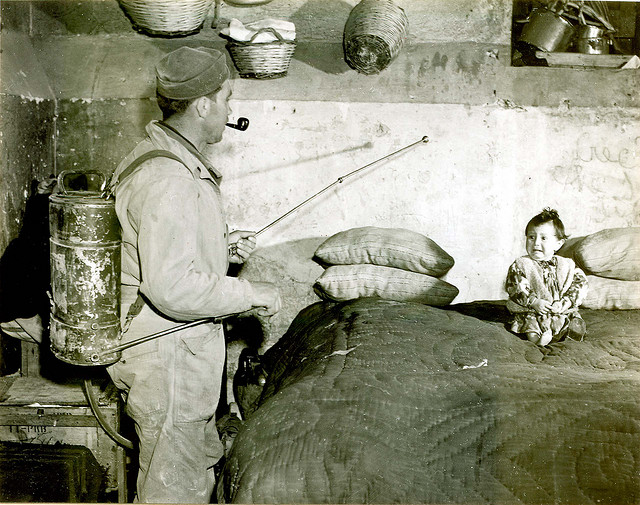
Image: A soldier sprays a mixture of DDT and kerosene in an Italian home. Spraying like this helped to drastically reduce malaria in Italy. Otis Historical Archives National Museum of Health and Medicine.