He had a floor you could eat off of, if you didn’t mind dirt.
Quote from an unwritten novel
Leave a reply
He had a floor you could eat off of, if you didn’t mind dirt.
Runaway sexual selection is a beautiful thing. Their calls are what got me interested, but their appearance is a real bonus.

Drug-based rituals, it is now becoming clear, played a central role in the emergence of Andean civilization. Rick believes Chavín’s ritual leaders invited elites from other regions to take part in elaborate ceremonies centered on ingesting powerful substances amid a dramatic sound and light show. In so doing, “they harnessed the process of mental alteration to establish powerful levels of authority.”
Chavín’s success spawned imitators throughout the region. In subsequent centuries, the Tiahuanaco and Wari peoples built on these traditions to cement political, social, and religious power as their territories expanded to encompass vast swaths of western South America. Widespread ritual drug use fell into decline only when the Inca rose after 1200 C.E.; Spanish conquerors suppressed remaining practices after their 1532 invasion. Although psychoactives remained in use for medicinal and small-scale religious purposes—many can still be found for sale in open-air markets—their powerful and pervasive influence on Andean society was relegated to the shadows.
Mind-altering drugs played key role in rise of Andean civilization | Science | AAAS

Colossal:
Con/struct is the latest body of work from Cape Town-based artist, designer, and photographer Justin Plunkett who uses his own original photography to digitally construct fictional landscapes and structures. He shares via an artist statement:
Con/Struct is an exploration into the themes of empowerment and imagination. Plunkett, using his own photography, has created new juxtaposed environments that encourage questioning and exploration: inviting the debate around how marketing- induced aspiration and perceived value can empower but can also corrupt, how it can be both perverse and create beauty. At the same time, at the core of his work, he honours and applauds ingenuity and the creative spirit.
Con/struct: The Fictional Urban Architecture of Justin Plunkett — Colossal
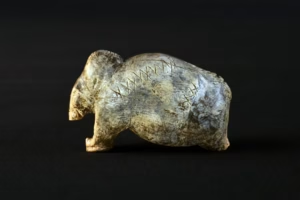
This is roughly twice as old as the oldest previously known proto-language (which among other things carried calendrical information about animal mating and birthing seasons). It’s mind-boggling to me that humans used abstract marks to carry information for tens of thousands of years before inventing true written language. Although I imagine the notion of ‘information’ would have been quite alien, which is part of why it was such a difficult leap.
The signs often occur in patterns — such as line, line, line or cross, cross, cross — which is not common in spoken language, according to the researchers. Some of the artifacts were discovered almost 100 years ago, but ongoing excavations are constantly unearthing new ones. Over the years, scholars have interpreted the markings to mean many different things, including hunting tallies, moon calendars, fur patterns or simply decoration.
“When I first had the result on screen, I could not believe it,” Bentz recalled about the moment he first looked at the computer analysis and saw a match between the older Stone Age markings and proto-cuneiform script found on more modern tablets from ancient Mesopotamia. “I sent a screenshot to my colleague.”
There seems to be a logic to the selection of symbols, according to Bentz. “On animal figurines, like mammoths and horses, but also on tools, we have crosses,” he said, “but we never find crosses on human figurines, so somehow there must have been a kind of taboo or convention to not put crosses onto human figurines.” Other studies have suggested that crosses could signify ritual killings, he added, so perhaps that’s why they weren’t found on sculptures of people.
Symbols found carved into 40,000-year-old German artifacts may be precursor to writing | CNN

Rainfall patterns are changing in many places. Individual trees adapt to the patterns they experience, so while the changes are hard on older trees, younger trees are better equipped for the new normal.
Trees experiencing drought alter their leaves, wood and roots in ways that prime them for continued dry conditions. Wood under drought might have smaller cells that are less vulnerable to future damage, and roots might increase relative to leaf area. These structural changes persist after the drought has passed and continue to influence the tree’s growth and ability to tolerate stress for many years.
Known as “legacy effects,” these lingering post-drought impacts represent an ecological memory of past climatic conditions at the tree and forest level. Knowing that trees hold a persistent memory of past dry phases, researchers wondered whether they might also show structural changes in response to past wet periods.
Eleven years after summertime irrigation started in Pfynwald, scientists stopped irrigating half of each plot in 2013 to address this question. The formerly irrigated trees, which at this point were about 120 years old, had experienced a lasting period of irrigation – but now those times of plenty were over.
Would the trees remember? A decade later, we found out.
There are some important caveats, but this seems like a significant step forward in synthetic biology (for better and for worse).
Prof. Kate Adamala and her team at the University of Minnesota have built SpudCell, a cell-like system constructed entirely from known chemical components that can perform a complete cell cycle.
The system contains 36 purified enzymes, a 90,000 base pair genome spread across nine separate DNA molecules, and a lipid membrane. SpudCell is able to grow, replicate its genome, divide, and undergo selection and competition across multiple generations.
Unlike earlier work on minimal cells that carved down living cells, SpudCell is built entirely bottom-up from individually purified, non-living components. It is the first time such a system has demonstrated a complete cell cycle.
Source: Biotic | SpudCell

One of the most nuanced pieces I’ve read on potential effects of AI art on artists.
The mistake is to assume that the meaning of “better” will stay the same. What’s more likely is that the goal posts will shift because we will move them. We have changed our collective tastes in response to technological progress in the past. We’ll now do it again, without even noticing that it’s happening. And if history is any indication, our tastes will evolve in a way that rigs the game in favor of human artists.It’s not surprising that in conceiving of a new world awash with AI art, we haven’t accounted for a society-wide change in taste. We tend to assume that in the future we will want the same things we want now, and that only the ability to achieve them will evolve. One famous study dubbed this the “end of history illusion”: People readily agree that their most strongly held tastes have changed over the past decade but then insist that from this point on those tastes will remain as they are. Having presumably reached some peak level of refinement, they can now rest idly in their self-assurance.In truth, what turns us on and off is constantly being reshaped by a range of powerful social forces, mostly beyond our awareness. Technological progress tops the list because it changes what is easy and what is difficult, and our running definitions of the beautiful and the vulgar are instantly affected by these criteria. When new advances expand the confines of what is possible, collective tastes respond—by wanting to partake of the new abundance and by wanting nothing to do with it.

The story of how Chernobyl has affected wildlife is complicated, argues Jonathon Turnbull, a geographer at Durham University. You can’t just say nature in the exclusion zone is thriving or dying, he says: “There’s the spectacular story of ‘Chernobyl changed everything’ – that doesn’t go very deep.”
Rather, there exists a menagerie of subtle effects and responses. An entire ecosystem that experienced a terrible disaster but kept living and growing. It’s no surprise, says Turnbull, that so many questions still litter this landscape 40 years on.
https://www.bbc.com/future/article/20260424-chernobyl-wildlife-forty-years-on
