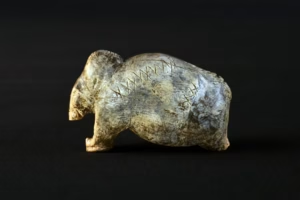
This is roughly twice as old as the oldest previously known proto-language (which among other things carried calendrical information about animal mating and birthing seasons). It’s mind-boggling to me that humans used abstract marks to carry information for tens of thousands of years before inventing true written language. Although I imagine the notion of ‘information’ would have been quite alien, which is part of why it was such a difficult leap.
The signs often occur in patterns — such as line, line, line or cross, cross, cross — which is not common in spoken language, according to the researchers. Some of the artifacts were discovered almost 100 years ago, but ongoing excavations are constantly unearthing new ones. Over the years, scholars have interpreted the markings to mean many different things, including hunting tallies, moon calendars, fur patterns or simply decoration.
“When I first had the result on screen, I could not believe it,” Bentz recalled about the moment he first looked at the computer analysis and saw a match between the older Stone Age markings and proto-cuneiform script found on more modern tablets from ancient Mesopotamia. “I sent a screenshot to my colleague.”
There seems to be a logic to the selection of symbols, according to Bentz. “On animal figurines, like mammoths and horses, but also on tools, we have crosses,” he said, “but we never find crosses on human figurines, so somehow there must have been a kind of taboo or convention to not put crosses onto human figurines.” Other studies have suggested that crosses could signify ritual killings, he added, so perhaps that’s why they weren’t found on sculptures of people.
Symbols found carved into 40,000-year-old German artifacts may be precursor to writing | CNN