Category Archives: Uncategorized

Web Kids’ manifesto

[Hell yeah. Well worth a read. -egg]

Web Kids’ manifesto:

Piotr Czerski’s manifesto, “We, the Web Kids,” originally appeared in a Polish daily newspaper, and has been translated to English and pastebinned. I’m suspicious of generational politics in general, but this is a hell of a piece of writing, even in translation.

Writing this, I am aware that I am abusing the pronoun ‘we’, as our ‘we’ is fluctuating, discontinuous, blurred, according to old categories: temporary. When I say ‘we’, it means ‘many of us’ or ‘some of us’. When I say ‘we are’, it means ‘we often are’. I say ‘we’ only so as to be able to talk about us at all.

1.
We grew up with the Internet and on the Internet. This is what makes us different; this is what makes the crucial, although surprising from your point of view, difference: we do not ‘surf’ and the internet to us is not a ‘place’ or ‘virtual space’. The Internet to us is not something external to reality but a part of it: an invisible yet constantly present layer intertwined with the physical environment. We do not use the Internet, we live on the Internet and along it. If we were to tell our bildnungsroman to you, the analog, we could say there was a natural Internet aspect to every single experience that has shaped us. We made friends and enemies online, we prepared cribs for tests online, we planned parties and studying sessions online, we fell in love and broke up online. The Web to us is not a technology which we had to learn and which we managed to get a grip of. The Web is a process, happening continuously and continuously transforming before our eyes; with us and through us. Technologies appear and then dissolve in the peripheries, websites are built, they bloom and then pass away, but the Web continues, because we are the Web; we, communicating with one another in a way that comes naturally to us, more intense and more efficient than ever before in the history of mankind.

Brought up on the Web we think differently. The ability to find information is to us something as basic, as the ability to find a railway station or a post office in an unknown city is to you. When we want to know something – the first symptoms of chickenpox, the reasons behind the sinking of ‘Estonia’, or whether the water bill is not suspiciously high – we take measures with the certainty of a driver in a SatNav-equipped car. We know that we are going to find the information we need in a lot of places, we know how to get to those places, we know how to assess their credibility. We have learned to accept that instead of one answer we find many different ones, and out of these we can abstract the most likely version, disregarding the ones which do not seem credible. We select, we filter, we remember, and we are ready to swap the learned information for a new, better one, when it comes along.

To us, the Web is a sort of shared external memory. We do not have to remember unnecessary details: dates, sums, formulas, clauses, street names, detailed definitions. It is enough for us to have an abstract, the essence that is needed to process the information and relate it to others. Should we need the details, we can look them up within seconds. Similarly, we do not have to be experts in everything, because we know where to find people who specialise in what we ourselves do not know, and whom we can trust. People who will share their expertise with us not for profit, but because of our shared belief that information exists in motion, that it wants to be free, that we all benefit from the exchange of information. Every day: studying, working, solving everyday issues, pursuing interests. We know how to compete and we like to do it, but our competition, our desire to be different, is built on knowledge, on the ability to interpret and process information, and not on monopolising it.

We, the Web Kids

(Thanks, @travpol!)


Autodesk 123D

[Holy effin moly. -egg]

Autodesk 123D:

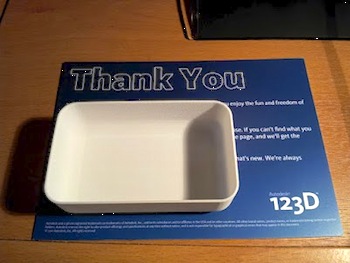
Printing in 3D is now no more complicated than printing photos in Picasa. First you design something in Autodesk 123D (in my case, my first project was a device housing prototype). Then pick “Make” from the menu. You can print your object on your desktop printer, like a Makerbot (moderate quality, now), or you press another button to have it printed (high quality, later) on a commercial printer. Enter your credit card (my prototype, shown here, cost $24) and a week later it’s delivered to your house. Wow.

Best of all, 123D is free. This is the future of fabrication.

— Chris Anderson

Autodesk 123d

Free

Windows-only (OSX support to come)

Available from and produced by Autodesk

Tuning in to ambient urban sound: Alex Braidwood’s "Listening Instruments"

[I used to do the same thing manually in the Philadelphia subways… -egg]

[Video Link, via LAist]

Los Angeles area radio station KPCC produced this lovely video portrait of designer, educator, and media artist Alex Braidwood. His work “explores methods for transforming the relationship between people and the noise in their environment.” In the video, you’ll see Alex wearing what I believe may be his Noisolation Headphones, “an invention for mechanically transforming the relationship between a person and the noise that immediately surrounds them.” His video about that project is below.


Lorenzo Oggiano’s Quasi-Objects"

Sent to you via Google Reader

Lorenzo Oggiano’s Quasi-Objects”

201202010917-1

According to artist Lorenzo Oggiano, his computer-generated art is made to…

…stimulate thought and dialogue on the progressive relativisation of natural forms of life as a result of techno-biological evolution. “Quasi-Objects” regards data actualization, the production of biologically non-functional organisms and ecosystems as transient output of an operative practice: aesthetics of process…

Life is a real and autonomous process independent from any specific material manifestation (Via Drawn)


Cop spends weeks to trick an 18-year-old into possession and sale of a gram of pot

[Oh, hey, were you needing something to be pissed off about? -egg]

Cop spends weeks to trick an 18-year-old into possession and sale of a gram of pot:

More fun from the self-loathing society: This American Life had a show about how young female undercover cops infiltrated a high school and flirted with boys to entrap them into selling pot, so they could charge them with felonies and destroy their lives at an early age.

Last year in three high schools in Florida, several undercover police officers posed as students. The undercover cops went to classes, became Facebook friends and flirted with the other students. One 18-year-old honor student named Justin fell in love with an attractive 25-year-old undercover cop after spending weeks sharing stories about their lives, texting and flirting with each other.

One day she asked Justin if he smoked pot. Even though he didn’t smoke marijuana, the love-struck teen promised to help find some for her. Every couple of days she would text him asking if he had the marijuana. Finally, Justin was able to get it to her. She tried to give him $25 for the marijuana and he said he didn’t want the money — he got it for her as a present.

A short while later, the police did a big sweep and arrest 31 students — including Justin. Almost all were charged with selling a small amount of marijuana to the undercover cops. Now Justin has a felony hanging over his head.

Sick: Young, Undercover Cops Flirted With Students to Trick Them Into Selling Pot (Via Aurich Lawson)


Documentary about inventor of giant 3D printer that can print a house

Documentary about inventor of giant 3D printer that can print a house:

The Man Who Prints Houses is a documentary about Enrico Dini, an Italian roboticist who switched tracks to design and build enormous 3D printers capable of outputting houses:

Having built his printer – the world’s largest – from scratch, there’s no shortage of work offers for this highly-skilled and imaginative engineer. Throughout the course of the film, we see Enrico embark on an array of innovative projects: constructing the tallest printed sculpture in existence, working with Foster + Partners and the European Space Agency on a programme to colonise the moon, solidifying a sand dune in the desert, and printing the closest thing to an actual house: a small Italian dwelling known as

a trullo.

The long-term nature of these projects and the current financial climate take their toll on Enrico and his team of workers, as contracts fail to be honoured and the infant technology stutters. Travel back to 2008 and it’s a different story, as Enrico describes how he was staring a €50m investment in the face.

Just as he’s about to sell up and move to London, the stock market crashes… he must rebuild his business all over again.

The Man Who Prints Houses

(Thanks, gaiapunk!)


White Stripes’ "Seven Nation Army" performed on things found in a laboratory

White Stripes’ “Seven Nation Army” performed on things found in a laboratory:

The Blast Lab at Imperial College, London, is a place where scientists study how explosions affect the human skeleton, and try to find ways to mitigate some of those effects. As you can imagine, this involves blowing stuff up fairly regularly and The Blast Lab is a pretty loud place.

But the team of students behind PLoS’ Inside Knowledge blog noticed something cool about that. The sounds in The Blast Lab weren’t just loud noises, they were loud notes. Edit them together, and you could reproduce a whole song, using nothing but sounds recorded in a working scientific laboratory.

In this video, the Inside Knowledge crew plays The White Stripes’ “Seven Nation Army” on the Imperial College Blast Lab. In case you’re curious, here’s the breakdown showing what lab equipment the team used to replicate the sound of which instruments.

Bass Guitar: Main sensor output cable

Bass Drum: Blast Rig

Toms: Hammer & Storm Case

Hi-Hat: Oil Spray

Cymbal: Blast Plate

‘Vocals’: Laces to contain dummy leg during blast

‘Guitar’: Accelerometer cable & Fastening Strings

Video Link

Submitterated by Ben Good


PlayFic: an online toolset and community for easily making text-adventure games

PlayFic: an online toolset and community for easily making text-adventure games:

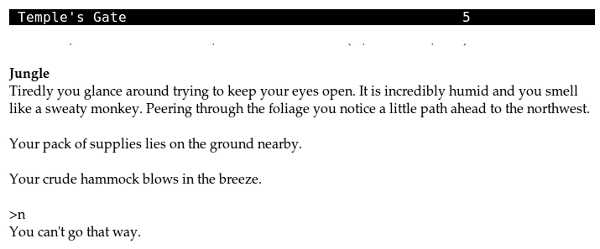
Andy Baio and his 15-year-old nephew Cooper McHatton created PlayFic, “a community for writing, sharing, and playing interactive fiction games (aka ‘text adventures’) entirely from your browser, using a ‘natural language’-inspired language called Inform 7.” Basically, it’s a site for making your own Zork-style games, sharing them, critiquing them, and collaborating on them. It includes a “view game source” button that, like the “view source” item in browsers, can be used to kick-start your own progress into creation by seeing how the work you admire is put together. Waxy sez,”

My hope is that Playfic opens up the world of interactive fiction to a much wider audience — young writers, fanfic authors, and culture remixers of all ages.

While the language can be tricky, building simple games is surprisingly easy. Cooper had never coded anything or made a game before trying Playfic, and within 30 minutes of futzing around, he’d made his first game.

Some stuff is broken and missing, but I’d love to hear what you make of it. Open to any and all feedback. Go make some games!

Playfic

(via Wonderland)