Egg substitute: “Real Egg Product”: “
When I want a substitute for an egg, I insist that the egg be substituted with an egg. (Thanks, Wendy!)

“
Egg substitute: “Real Egg Product”: “
When I want a substitute for an egg, I insist that the egg be substituted with an egg. (Thanks, Wendy!)
“
Remote controlled cockroach: “
Our pals at Backyard Brains (makers of the terrific SpikerBox kit, which allows you to study the electrical impulses of insect neurons) are developing circuitry to control which direction a cockroach walks.
By modifying the HEXBug toy ‘Inchworm’ circuitry to deliver pulses, we stimulated the antenna nerves of the discoid cockroach to ‘trick’ the cockroach into turning upon command. Stay tuned! as we make the preparation easier, more reliable, and lighter!
Working RoboRoach Prototype (Via Make)
“
Let us now praise infamous alchemists: “
The George Sarton Memorial Lecture—an annual presentation on the history of science, which takes place as part of the AAAS meeting—is rapidly becoming one of my absolute favorite lecture series. (C’mon, we all have a list of favorite lecture series, right?) In 2010, the Sarton Lecture introduced me to the story of how scientists came to use the concept of averages—remaking science from an art, into, well, a science.
In 2011, the topic was alchemy. According to speaker Lawrence Principe of Johns Hopkins University, alchemy has an unfairly bad rep. Sure, turning lead into gold is a pipe dream. But alchemists weren’t the total nutters they’re often made out to be. Instead, while their theories were often silly, the work of alchemists still managed to be very important and influential, forming the backbone of several major fields of science. These guys were were wrong, the Economist writes, but wrong in interesting ways.
The real problem with alchemy … was that it was not sceptical enough. Alchemical theories were not stupid. For instance, lead ore often contains silver and silver ore often contains gold, so the idea that lead ‘ripens’ into silver, and silver into gold, is certainly worth entertaining. The alchemists also discovered some elements, such as phosphorous. But in the end, too many alchemists would not let go of their theories, even as knowledge advanced.
To illustrate how alchemists were thus bamboozled, Dr Principe conducted an alchemical experiment using the notebooks of George Starkey, an alchemist who was born in Bermuda, educated in Massachusetts and then lived in England, where he worked alongside Boyle. The experiment which Dr Principe reconstructed showed just how alchemists might truly have believed they were thinking the right way about the transmutation of metals.
Following Starkey’s recipe, a formula that took weeks to prepare, Dr Principe made what Starkey had believed was philosophical mercury–a crucial ingredient of the Philosopher’s Stone that would ripen lead into gold. Alchemical theory was rife with botanical analogies of ripening, growth and seeding. When Dr Principe prepared philosophical mercury (actually an amalgam of mercury, gold and a small amount of antimony) according to Starkey’s instructions, a strange thing happened. As it solidified, it grew into a treelike structure. For someone primed by his theory to see transmutation as akin to a biological process, this must have been a wonderful confirmation that he was on the right line, and that the Philosopher’s Stone was just around the corner.
It was not, of course.
There’s more great insight on alchemy—and its connection to neuroscience—on Carl Zimmer’s blog, The Loom.
“
Cornell University and the French Culinary Institute are collaborating to modify 3D printers to output delicious, detailed, edible objects. They puree materials such as ‘chocolate, cheese and hummus to scallops, turkey, and celery’ and feed them to at Fab@Home open-source 3D printer. Shown here is a tiny Space Shuttle made of ground scallops and cheese.
‘It lets you do complex geometries with food that you could never do by hand,’ said Jeffrey Lipton, a researcher and graduate student at the lab…’‘…I can imagine creating really interesting textures using meat with the same technique,’ [Dave Arnold, director of culinary technology at the French Culinary Institute in Manhattan] told Spark. ‘Imagine [a food] almost like a meatloaf that absorbs sauce like a sponge. That is cool — much cooler to me than printing some ersatz steak.’
3D printers create edible objects
Printing Food (Cornell University)
(Image: Cornell University/French Culinary Institute)
“
Computational architect Michael Hansmeyer makes incredibly elaborate columns out of cardboard and wood. Co.Design‘s John Pavlus writes: ‘Hansmeyer’s column stands nine feet tall, weighs about 2000 pounds, and is made out of 2700 1mm-thin slices of cardboard stacked on top of wooden cores. It contains somewhere between 8 and 16 million polygonal faces — too complex for even a 3D printer to handle, according to Hansmeyer.’
The World’s Most Complex Architecture: Cardboard Columns With 16 Million Facets [Co.Design via Inhabitat]
Columns [Michael’s website]
“
Get chased by zombies in Google Streetview!: “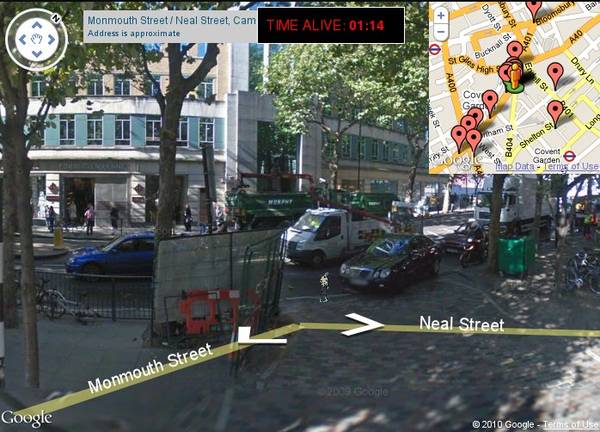
Mike Lacher’s ‘Streetview Zombie Apocalypse’ is a great Google Streetview mashup: enter your location and then watch (and flee) as zombies converge upon you from all directions. I managed to get about 10 blocks from my flat before they caught me. It was surprisingly intense!
(Thanks, Mope, via Submitterator!)
“
Spanish Castle Magic: living towers made of humans: “
Video by Mike Randolph:
In the city of Tarragona, Spain, castellers gather every two years to see who can build the highest, most intricate human castles. This uniquely Catalan tradition requires astonishing strength, finesse, and balance. Not to mention courage.
Here are more photos of this amazing sport.
(thanks, Clayton Cubitt)
“
Detroit will pay you to take one of its houses: “
Photo by Kevin Bauman. See more of Kevin’s stunning photos of abandoned Detroit homes.
From Business Insider:
Mayor Dave Bing is trying to save Detroit by offering incentives to lure residents back to abandoned neighborhoods.
One program offers $150,000 in housing renovation money and requiring only $1,000 down to police officers who are willing to relocate to the city. Another offers college graduates $2,500 to rent and $20,000 forgivable loan to buy properties.
Potential home buyers can choose from plenty of cheap or free homes, especially in the blighted neighborhoods of Woodward Ave. and Brush Park.
Detroit Will PAY You To Take One Of These 100 Abandoned Homes
“


