Genki Sudo and World Order: "Machine Civilization"

[Just some sick, sick choreography here. You should really watch it. -egg]

Genki Sudo and World Order: “Machine Civilization”:

[Video Link] Genki Sudo and World Order, “MACHINE CIVILIZATION.” An amazing piece of choreography, link sent to us by David Byrne, via Brian Eno. The Coilhouse folks blogged more details about this work when it first came out in April; it is a response to the March 11 earthquake, tsunami, and nuclear disaster. You can buy the album here.


Secret records of US bank bailout released, over howls of protest

Sent to you via Google Reader

Secret records of US bank bailout released, over howls of protest

Bloomberg has won a lengthy Freedom of Inforn battle to get the details of a secretive, no-strings-attached multi-trillion-dollar payout from the Bush administration (continued by the Obama administration) to banks, the details of which were not available to Congress. The documents make it clear that the banks’ posture that they were only borrowing the money to help the government (JP Morgan said it borrowed “at the request of the Federal Reserve to help motivate others to use the system”) were purest refined BS. Morgan for example, had borrowed twice its cash holdings.

The Fed, headed by Chairman Ben S. Bernanke, argued that revealing borrower details would create a stigma — investors and counterparties would shun firms that used the central bank as lender of last resort — and that needy institutions would be reluctant to borrow in the next crisis. Clearing House Association fought Bloomberg’s lawsuit up to the U.S. Supreme Court, which declined to hear the banks’ appeal in March 2011.

The amount of money the central bank parceled out was surprising even to Gary H. Stern, president of the Federal Reserve Bank of Minneapolis from 1985 to 2009, who says he “wasn’t aware of the magnitude.” It dwarfed the Treasury Department’s better-known $700 billion Troubled Asset Relief Program, or TARP. Add up guarantees and lending limits, and the Fed had committed $7.77 trillion as of March 2009 to rescuing the financial system, more than half the value of everything produced in the U.S. that year.

“TARP at least had some strings attached,” says Brad Miller, a North Carolina Democrat on the House Financial Services Committee, referring to the program’s executive-pay ceiling. “With the Fed programs, there was nothing…”

Lawmakers knew none of this.

They had no clue that one bank, New York-based Morgan Stanley (MS), took $107 billion in Fed loans in September 2008, enough to pay off one-tenth of the country’s delinquent mortgages. The firm’s peak borrowing occurred the same day Congress rejected the proposed TARP bill, triggering the biggest point drop ever in the Dow Jones Industrial Average. (INDU) The bill later passed, and Morgan Stanley got $10 billion of TARP funds, though Paulson said only “healthy institutions” were eligible.

Secret Fed Loans Gave Banks Undisclosed $13B

(via The Awl)

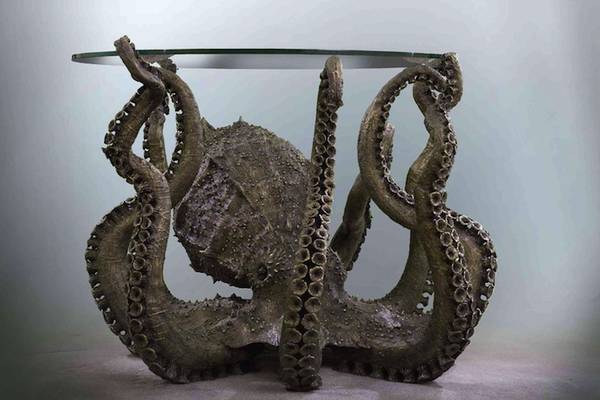
Octopus table

Sent to you via Google Reader

Octopus table

Isaac Krauss’s octopus table is a fantastic piece of work — I want a giant brass octopus for my house!

Then, while taking his first bronze sculpting course, Krauss unearthed the idea and set to work. He admits to having had very little experience working with bronze, but felt that stretching beyond his limits would push him as an artist. The most difficult aspect of this project, according to Krauss, was the detailed suction cups and applying them to the octopuses eight arms. For this, a close friend of his helped him out and also assisted in carrying through with the project till its completion. Overall, it took 1500 hours of work and $5000 to create this marvelous piece of art.

Awe-Inspiring Octopus Table

(via Neatorama)


What’s on Leonardo daVinci’s "To-Do" list?

Sent to you via Google Reader

What’s on Leonardo daVinci’s “To-Do” list?

The above image is an illustrated and translated version of an actual “to-do” list written by Leonardo da Vinci. It was put together for NPR by Robert Krulwich and illustrator Wendy MacNaughton, based on information found in a new book, Da Vinci’s Ghost: Genius, Obsession, and How Leonardo Created the World in His Own Image, by Toby Lester.

What does a list like this tell us about the guy who wrote it? Krulwich sees in this list an example of what the brain can do when it’s allowed to really wander. Maybe you’re better off not being able to focus very well on one specific thing:

“We live in an age that worships attention,” says my friend (and Radiolab colleague) Jonah Lehrer. “When we need to work, we force ourselves to concentrate. This approach can also inhibit the imagination. Sometimes, it helps to consider irrelevant information, to eavesdrop on all the stray associations unfolding in the far reaches of the brain.”

Minds that break free, that are compelled to wander, can sometimes achieve more than those of us who are more inhibited, more orderly, [a scientific study] suggests. Or, as Jonah chose to put it, there are “unexpected benefits of not being able to focus.”

That’s not a bad point. But I see something else here as well. Take another look at that to-do list. I think it’s pretty interesting that of the nine tasks shown, six involve consulting and learning from other people. Leonardo da Vinci needs to find a book. Leonardo da Vinci needs to get in touch with local merchants, monks, and accountants who he hopes can help him better understand concepts within their areas of expertise.

Leonardo da Vinci knows he doesn’t know everything.

I think that’s a big deal.