Our Favorite Single-Purpose Web Sites That Do Exactly What They Say They Do
Nanomaterial is world’s lightest
Sent to you via Google Reader
Nanomaterial is world’s lightest

A new material developed by scientists at UC Irvine is described as the “world’s lightest material,” so light it can perch atop a dandelion clock without disturbing the seeds. The material is documented in the Nov 18 Science.
The new material redefines the limits of lightweight materials because of its unique “micro-lattice” cellular architecture. The researchers were able to make a material that consists of 99.99 percent air by designing the 0.01 percent solid at the nanometer, micron and millimeter scales. “The trick is to fabricate a lattice of interconnected hollow tubes with a wall thickness 1,000 times thinner than a human hair,” said lead author Dr. Tobias Schaedler of HRL.
The material’s architecture allows unprecedented mechanical behavior for a metal, including complete recovery from compression exceeding 50 percent strain and extraordinarily high energy absorption.
Multidisciplinary team of researchers develop world’s lightest material
(Thanks, Fipi Lele!)
(Image: Dan Little, HRL Laboratories LLC)
Interview with creator of Occupy Wall Street "bat-signal" projections during Brooklyn Bridge #N17 march
[Single awesomest action of OWS to date. I love love love it. -egg[
Interview with creator of Occupy Wall Street “bat-signal” projections during Brooklyn Bridge #N17 march:
[Video Link]. Earlier this evening, tens of thousands of Occupy Wall Street protesters marched throughout New York City, many making their way on to the Brooklyn Bridge, carrying LED candles and chanting. As Occupiers took the bridge in a seemingly endless sea of people, words in light appeared projected on the iconic Verizon Building nearby:
“99% / MIC CHECK! / LOOK AROUND / YOU ARE A PART / OF A GLOBAL UPRISING / WE ARE A CRY / FROM THE HEART / OF THE WORLD / WE ARE UNSTOPPABLE / ANOTHER WORLD IS POSSIBLE / HAPPY BIRTHDAY / #OCCUPY MOVEMENT / OCCUPY WALL STREET / list of cities, states and countries / OCCUPY EARTH / WE ARE WINNING / IT IS THE BEGINNING OF THE BEGINNING / DO NOT BE AFRAID / LOVE.”

A few hours later I spoke with Mark Read, the person behind the “bat-signal.” He tells Boing Boing why and how he did this, and what technology he used.
XJ: How did this come together?
Mark Read: It came up at an action coordination meeting. We were talking about what to do on the 17th, about the decentralized way the day would progress, attacking the exchange from different angles. We had a sense that the morning on Wall Street would be forceful and confrontational, and we wanted to not do the same kind of thing in the afternoon. Initial talks focused on having a thousand people taking the bridge in the afternoon, and continuing in a militant mode of activism. But we started thinking about creating a more unifying moment. A celebration of the birthday of Occupy Wall Street. Maybe taking the roadway and having lots of arrests might not be best thing. What if we took the pedestrian walkway, and gave out LED candles? We would give out 10,000 LED tea candles, a river of light streaming over the walkway.
And a guy named Hero, who has been central to a lot of facets of the occupation since the beginning, turns to me and says, “We need a bat signal. The 99%.”
I said, I think I can do that. I know just enough about how the technology works that I think I can pull that off. And for the past two weeks, I’ve worked full time on figuring that out.

My friend Will Etundi, who I know from these renegade street parties, the alter-globalization movement, carnivals against capitalism — he’s part of a community of friends who deploy spectacle and art in the service of radical politics. Will and I have done other events that were about getting people into public space. Transforming the normal way we use space, turning it into a party, a roving community, something festive and mobile. Through that work, I’d already met people with a variety of skill sets, strange and magical abilities. I got in touch with them right away, and started pulling together a team. Who would have a 12K lumen projector, a big expensive piece of equipment, the most powerful projector you can get?
I knew I wanted to throw it on the Verizon Building. Everyone who lives in New York has looked at that big monolithic structure. For some of us, every time we look at it we think of how cool it would be as a projection surface.
I knew we’d need a powerful projector. But if you had something that expensive on loan for free, you couldn’t just sneak it up on some roof and be in jeopardy.
I knew I had to find someone who lived in a building nearby.
XJ: How did you go about finding someone nearby who would allow you stage this from inside their home?
MR: Opposite the Verizon building, there is a bunch of city housing. Subsidized, rent-controlled. There’s a lack of services, lights are out in the hallways, the housing feels like jails, like prisons. I walked around, and put up signs in there offering money to rent out an apartment for a few hours. I didn’t say much more. I received surprisingly few calls, and most of them seemed not quite fully there. But then I got one call from a sane person
Her name was Denise Vega. She lived on the 16th floor. Single, working mom, mother of three.
I spoke with her on the phone, and a few days later went over and met her.
I told her what I wanted to do, and she was enthused. The more I described, the more excited she got.
Her parting words were, “let’s do this.”
She wouldn’t take my money. That was the day of the eviction of Zuccotti, the same day. And she’d been listening to the news all day, she saw everything that had happened.
“I can’t charge you money, this is for the people,” she said.
She was born in the projects. She opened up her home to us.
She was in there tonight with her 3 daughters, 2 sisters. The NYPD started snooping around down on the ground while the projections were up, it was clear where we were projecting from, and inside it was festive.
“If they want to come up they’re gonna need a warrant!,” her family was saying. “If they ask us, well, we don’t know what they are talking about!” They were really brave and cool.
XJ: Who wrote the words?
MR: I did. A lot of it is just chants that we’ve heard. ” We are the 99%,” everyone knows that one. “We are unstoppable, another world is possible,” a bunch of chants that have circulated around. “We are winning.”
There’s one you’d see internationally, when Zapatistas are marching on the zocalo, and it circulated thorugh radical circles. “Failure isn’t possible,” is another I wanted to use, which I don’t think made it in there.
And “It’s the beginning of the beginning.” I loved that one. So frequently, things happen in the world that make it feel like we’re at the beginning of the end. But — “the beginning of the beginning,” what a radically optimistic statement that is.
The scale of the environmental and economic crisis we are facing, it’s extraordinary. This movement is a response to that crisis. Our leaders aren’t responding to any of that in a way that is commensurate to the crises we face. And that one sign has always spoken to me. We have to throw off our despair about the future world we might be facing, because if we come together as people and humanity, we can change it. And what Occupy Wall Street makes me feel is that for the first time in a long time that might be possible.
That means a lot to me. This is choosing hope over despair. This is actively and resolutely making that choice. It’s not going to be easy. It’s not going to be over in two months. It’s not going to be just the result of conversation.
XJ: How old are you?
MR: I’m 45. The people who worked on this are a diverse range of ages. Some are in their 20s, but not all of us are that young. It’s hard to study what’s happening in the environment and with the global economy and not feel afraid. There is a lot to fear. One of the things we were projecting tonight, it was Max’s idea. “Do not be afraid.” And I think that’s so important.
XJ: This event was to mark the two-month anniversary of Occupy Wall Street. We recently passed the ten-year anniversary of 9/11, and in a way, your message seems like a kind of antidote to the climate of fear that followed.
MR: I guess it is. I watched 9/11 happen from my rooftop in Park Slope. I was there. It’s been a crazy decade since then, a fearful time. And our leaders have stoked those fears, there’s been a lot of fear mongering. It’s been like that for a decade, and it feels like we are turning a page. I know we’re heading into winter in New York, but this feels like springtime.
XJ: Who did the graphics, and what tools did you use to create the sequence, and project it?
MR: Max Nova and JR Skola, from the art group Dawn of Man. They are video projectionists, and artists.
They have done stuff in Zuccotti Park. I didn’t know how i was going to put together the graphics, I’d been running around for the last two weeks trying to coordinate the team — you have to be able to live mix it, you need to understand how to make projections look right coming to the surface from an extreme angle, you need to be a VJ, and i’m not. So Max wound up being the guy. They used Modul8 VJ mixing software, a Sony 12K lumen projector that sells for around $10K. It’s huge. It’s more than 3 feet long, about 2 feet wide.
The whole thing was a combination of high tech and super jerry-rigging on the fly. The Modul8 software we were using can do amazing things: sense the angle you’re projecting at, even if it’s extreme, and modify the image so it looks straight. But then, we held the projected in place with gaffer tape, a broomstick, some baling wire. We only had 20 minutes to get it ready.
XJ: Were you worried about getting in trouble with the police?
MR: I was so sure it was not against the law, but I didn’t ask my lawyer friends. I didn’t want to really know. The
police knew where we were, they were pointing up to the window. But no one stopped us when we left.
XJ: When did you get a sense of the reaction the Occupiers had, when they were marching on the bridge and saw the projections?
MR: Oh, we could hear the crowd from the window. We heard them screaming, yelling. We had this idea that we would be able to mic check a short speech, and we timed the words so that it would fit with exactly how people would chant, just as they had been chanting these things for weeks.
XJ: Now that it’s done, how do you feel?
MR: I feel immense gratitude to these youngsters for kicking my ass into gear. I’m feeling so much gratitude
to everyone, for putting their bodies on the line every day, for this movement. It’s a global uprising we’re part
of. We have to win.
(Special thanks to @gemini_scorpio)
- After massive marches throughout NYC, Occupy Wall Street …
- #OWS Verizon Building “bat signal” projections during Brooklyn Bridge march
- Occupy Wall Street Occupies Wall Street: #N17
Time Twister – LEGO Mindstorms digital clock
[More clock porn. -egg]
Time Twister – LEGO Mindstorms digital clock:
[Video Link] Hans Andersson’s Time Twister clock, made from Lego Mindstorms components, is very clever!
I have always been fascinated with time and clocks. Time Twister is my first clock invention.
Time Twister consists of two LEGO Mindstorms bricks communicating via Bluetooth. The master brick keeps track of the time and handles the minute digits. The slave brick handles the hour digits and the second indicator.
Each digit is made up of five layers with black and white tiles layed out in different patterns. Each layer can rotate 360 degrees before it hooks to the next layer. By twisting the top layer back and forth in a specific pattern, you can arrange the layers so that the desired digit is displayed.
Antikythera mechanism in a wristwatch
[Yum. I’m not a sucker for watch porn usually, but…it’s the Antikythera mechanism. Lustful sigh. -egg]
Antikythera mechanism in a wristwatch:

Swiss luxury watch company Hublot has announced a version of the Antikythera mechanism, an ancient Greek astronomical calculator, that is incorporated into a wristwatch. The mechanism is to be displayed at the 2012 Baselworld expo before moving to a permanent exhibit at Musée des arts et métiers in Paris.
Hublot painstakingly recreates a mysterious, 2,100-year-old clockwork relic – but why?
(Thanks, Richard!)
OWS: NYPD occupy Zucotti Park, but what are their demands?
Sent to you via Google Reader
OWS: NYPD occupy Zucotti Park, but what are their demands?
OWS, bloodied but unbowed, has made a rather good funny:
“What are their demands?” asked social historian Patrick Bruner. “They have not articulated any platform. How do they expect to be taken seriously?”
Critics of the new occupation allege that meddling billionaire Michael Bloomberg is behind the movement. Others question the new occupiers’ militant posture, concerned about the potential effects on the neighborhood.
“I suppose they have a right to express themselves,” said local resident Han Shan. “But I’d prefer it if instead they occupied the space with the power of their arguments.”
NYPD Occupying Liberty Square; Demands Unclear
(Thanks, A Brooklyn Occupier!)
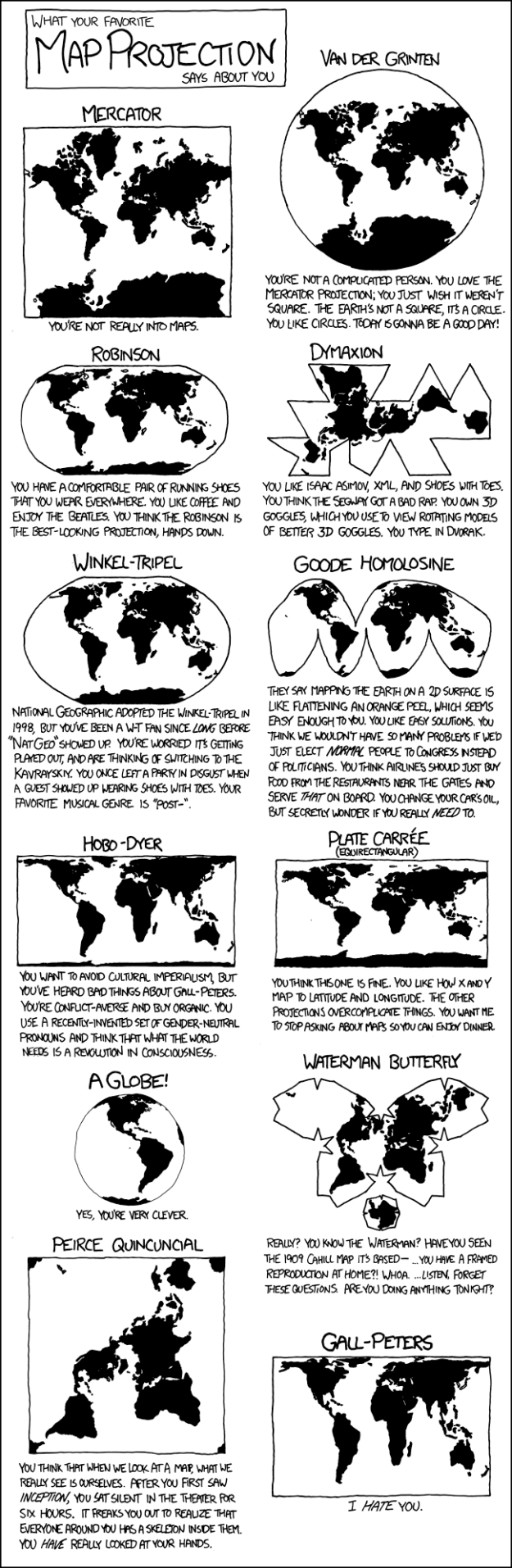
Map Projections
The Extraordinary Catalog of Peculiar Inventions: Vintage Arsenal of Masonic Pranksters
Sent to you via Google Reader
The Extraordinary Catalog of Peculiar Inventions: Vintage Arsenal of Masonic Pranksters
What Elks, Moose, and Shriners have to do with a fake guillotine and a goat on wheels.
 Freemasonry was born out of medieval craft guilds — working men distinguished by their freedom, not bonded into serfdom, indenture, or slavery. Their ceremonies and regalia were legendary, and their initiations mimicked harsh entries into religious order, initiations which might involve ritual humiliation, pain, or fear. Masons were primarily aristocratic, and if not wealthy, then at least refined. The fraternal lodges of the Elks, the Shriners, the Woodsmen, and the Moose, to name a few, offered a more casual form of brotherhood. Developed with masonic screeds in mind, they populated small towns and suburbs and its provided its members with a reason to get together once or twice a week. What they did each week was up to the members, sometimes they provided food and drink, more often they would debate bylaws and initiation fees (the lodges were originally developed to provide insurance for injured workers). Things could get a little sleepy.

Enter the DeMoulin brothers and their wonderfully strange DeMoulin Brothers catalogs, collected by New Yorker cartoonist Julia Suits in her new book, The Extraordinary Catalog of Peculiar Inventions. In 1892, a Woodsman lodge member asked his friend Ed DeMoulin to make him something that would really shake up dull lodge meetings. DeMoulin owned a local factory that manufactured uniforms, flags, patches, hats, seating, upholstery, and regalia of all kinds, and he was also at heart a trickster. When the Woodmen asked him to come up with a set piece that would really impress and scare the newly initiated, he delivered something darkly delightful: The Molten Lead Test, a flaming pot of seemingly boiling metal that turned out to be nothing more than mecurine powder dissolved in water (an element still not without its hazards). The pledge was convinced he was being burnt with hot lead, and the lodge would laugh uproariously at his misfortune.
Astounding 3D effects projected onto a building’s facade
[Wow. -egg]
Astounding 3D effects projected onto a building’s facade:
This LG mobile phone ad “event” projected a startling and well-conceived montage of 3D effects onto a building’s facade in Berlin. It’s all very spectacular and beautiful — pretty amazing for an ad (though I can imagine that if a whole city were taken over by this sort of advertising every night, it would be rather tedious). Meanwhile, I seriously covet that projector, which is blasting out enough lumens that I wonder if it incinerates small insects that stray into the path of the beam. I could get into serious mischief with one of those.
LG Optimus Hyper Facade in Berlin – Long Version
(Thanks, Dad!)