
 back
|
|
 digg
digg  facebook
  reddit
  stumbleupon
“
[Can’t remember if I posted this already. -egg]
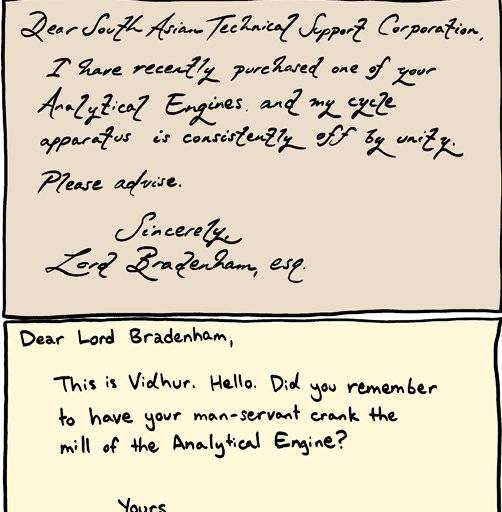
Today’s Saturday Morning Breadfast Cereal webcomic posits a funny, notional correspondance between an unhappy Analytical Engine owner and the South Asian Technical Support Corporation.
Difference Engine Tech Support
(Thanks, Pineapplecharm!)

“
Top Shelf Jazz’s video for “Gentlemen in Squalor” — smutty Prohibition jazz: “
Gonz sez, ‘The filthy swingers, Top Shelf Jazz, have released a new video for their song ‘Gentlemen In Squalor.” See my review of their last CD: Top Shelf Jazz’s ‘Fast and Louche’ — part Cab Calloway, part Atomic Fireballs, all good smutty Prohibition jazz
‘Gentlemen in Squalor’ Top Shelf Jazz
(Thanks, Gonz!)
“
Raising a kid without disclosing its sex: “Kathy Witterick and David Stocker are raising a kid in Toronto without disclosing its sex to anyone except its older siblings and grandparents. Its siblings are boys, but choose whether they wear ‘girl’s’ clothes or ‘boy’s’ clothes and get to pick their own toys. The parents attribute their childrearing notions to being reared on Free to Be… You and Me. I like the section in the article about bullying: ‘When faced with inevitable judgment by others, which child stands tall (and sticks up for others) — the one facing teasing despite desperately trying to fit in, or the one with a strong sense of self and at least two ‘go-to’ adults who love them unconditionally? Well, I guess you know which one we choose.’
‘When the baby comes out, even the people who love you the most and know you so intimately, the first question they ask is, ‘Is it a girl or a boy?” says Witterick, bouncing Storm, dressed in a red-fleece jumper, on her lap at the kitchen table.‘If you really want to get to know someone, you don’t ask what’s between their legs,’ says Stocker.
The moment a child’s sex is announced, so begins the parade of pink and barrage of blue. Tutus and toy trucks aren’t far behind. The couple says it only intensifies with age.
‘In fact, in not telling the gender of my precious baby, I am saying to the world, ‘Please can you just let Storm discover for him/herself what s (he) wants to be?!.’ Witterick writes in an email.
Parents keep child’s gender secret
(Thanks, Mom!)
“
Micro-origami sculptures unfolding in water through capillary action: “
Etienne Cliquet’s ‘Flottille’ shows ‘micro-origami’ of 2-3cm sheets of paper, intricately cut and folded, being placed in water; the sculptures draw the water in by capillary action and gracefully unfold.
(via Kottke)
“
Wood is good: beautiful NTT Docomo ad for TV in Japan: “
[Video Link] Matt Alt says, ‘This television ad for NTT Docomo came out right around the time of the earthquake, so it got lost in the news. But it’s really beautiful — and quintessentially Japanese.’ The YouTube metadata says, ‘No CG or tape-cut. Four days spent.’
“
Partitura: Mesmerizing Music Visualization Software: “
What neurological phenomena have to do with software and the future of live performance experiences.
Music visualization deeply fascinates and inspires me, from how it’s manifested in outlier phenomena like synesthesia to how it’s codified in the visual language of music notation to how it’s leveraged in artistic expression. Partitura explores this topic from a software standpoint with spellbinding generative real-time graphics that visualize sound. A collaboration between London-based visual artist Quayola and music visualization artists Pedro Mari and Natan Sinigaglia, the software churns out endless, mesmerizing, ever-evolving abstract shapes that can respond both the structure of recorded music and manual gestural inputs.


Partitura aims to create a new system for translating sound into visual forms. Inspired by the studies of artists such as Kandinsky, Paul Klee, Oscar Fischinger and Norman McLaren, the images generated by Partitura are based on a precise and coherent system of relationships between various types of geometries.” ~ Quayola
Partitura feels like a three-dimensional version of the wonderful Soy Tu Aire, equal parts fluid and vibrant, with incredible potential for live performances and multisensory ambient experiences.
via Create Digital Motion via ArtsTech News
 Brain Pickings has a free weekly newsletter and people say it’s cool. It comes out on Sundays and offers the week’s best articles. Here’s an example. Like? Sign up.

Brain Pickings takes 450+ hours a month to curate and edit across the different platforms. If it brings you any joy and inspiration, please consider a modest donation – it lets us know we’re doing something right and helps keep the lights on.

“
I’ve cited McKenna a lot over the years. The last of the great American magical thinkers, at least for a while – no-one’s followed him with any success, although many, both genuine apostles and creepy chancers, have tried. The last half of his life was pretty much a public exegesis, trying to quantify and contextualise his drug experiences in the same way that Philip K Dick obsessively wrote his own self-interrogative Exegesis document. He sometimes conflated his UFO experience with his fascination with psylocibin, conflating it with the neurochemical payload of the mushroom. Even his visualisation of the UFO, as a classic George Adamski vehicle, has something of the bemushroomed about it.
Two things to note about McKenna’s experience. One, he sat in a very particular place, on the advice of a local contact, and told to watch a very specific portion of the sky. UFO appearances were apparently semi-regular in this area. I don’t know exactly where McKenna was, but neighbouring Chile and Peru sit on the join between the Nazca and South American tectonic plates… and while central Brazilian “mid-plate events” are supposedly fairly rare, they do happen, and they can happen deep in the remote Amazon forest. I like to imagine the young McKenna sitting in the Amazon basin without a clue that he was actually in some vast electromagnetic well, the South American plate beneath his feet flexing and cracking under weird torsion… and then there is strange weather, there are earthlights, and Terence McKenna’s magnetically-boiled temporal lobe sees whatever’s throwing itself out of the ground as burning hauntology, as a ghost of space, as memories of the future…
(Nazca, of course, bears on its plains huge geoglyphs that Erich von Daniken claimed, in his book CHARIOTS OF THE GODS, could be nothing less than airfield markings for alien spacecraft.)
“

