A Peek Inside Japanese Candy Sculptor Shinri Tezuka’s Amezaiku Studio

[The video is really worth watching 🙂 -egg]

At the age of only 27, self-taught candy sculptor Shinri Tezuka (previously) may be one of the youngest practitioners of amezaiku, the dwindling art of candy crafting. Even though the craft dates back hundreds of years, there are only two known candy makers in all of Tokyo who roll, sculpt, and paint lollipops in this manner. Great Big Story recently stopped by Tezuka’s workshop for a quick video interview you can see below.

[Couldn’t embed the video, but here it is:]

Source: A Peek Inside Japanese Candy Sculptor Shinri Tezuka’s Amezaiku Studio

Election 2016: Hating Hillary | The Economist

[Very interesting to read a British take on Clinton’s unpopularity. -egg]

Mrs Clinton’s former congressional colleagues—including the Republicans she wooed assiduously on Capitol Hill, though they had sought to destroy her husband’s presidency, and her, in the 1990s—speak even more admiringly of her. “I got on very well with her, she’s a likeable person. When it comes to dealing with Congress, she’d be a big improvement on Barack Obama,” says Don Nickles, a former Republican senator from Oklahoma who helped wreck the health-care reform Mrs Clinton tried to launch in 1993, and with whom she then worked to extend unemployment benefits. “She’s hard-working, true to her word and very professional,” says Tom Reynolds, a former Republican congressman who collaborated with her in upstate New York. “That’s not just in the Senate. She’s been like that all her life.”

This, to put it mildly, is not a characterisation supported by Mrs Clinton’s ratings. Around 55% of Americans have an unfavourable view of her; about the same number do not trust her (see chart). Yet, among those who know Mrs Clinton, even critics praise her integrity. She is a politician, therefore self-interested and cynical at times—yet driven, they say, by an overarching desire to improve America. More surprising, given the many scandals she has been involved in, including an ongoing furore over her use of a private e-mail server as secretary of state, not many of those who have dealt with her seem to think her particularly shifty. Even some of her foes say the concern about her probity is overblown. “People can go back decades and perhaps criticise some of the judgments that were made,” Michael Chertoff, who was the Republican lead counsel in one of the first probes into Mrs Clinton, the Senate Whitewater Committee, but has endorsed her, told Bloomberg. “That is very, very insignificant compared to the fundamental issue of how to protect the country.”

What then explains the depths of Mrs Clinton’s unpopularity, which on November 8th will drive millions of Americans to justify voting for a man whom they have heard boast of groping women? Having opened up a six-point lead in recent weeks, she is nonetheless likely to prevail. Yet she would return to the White House as its most-reviled new occupant of modern times. Mr Trump has suggested she could even be assassinated—and the experience of his rallies suggests he might be right. Neck veins thrumming, his supporters call Mrs Clinton “evil”, and a “killer”.

Source: Election 2016: Hating Hillary | The Economist

The Leftist Case for Clinton – Medium

[I learned a bunch of interesting stuff from this. -egg]

 I consider myself to the left of Sanders on nearly all domestic issues, and I lean heavily towards non-intervention in foreign affairs, particularly in the Middle East.

I voted for Clinton not to preserve the center-left establishment, but because I believe she’s the single person best positioned to co-opt the existing institutional framework and advance my values in the world.

Source: The Leftist Case for Clinton – Medium

Hillary Clinton and the Populist Revolt – The New Yorker

[A well-written and wide-ranging essay about Republicans, Democrats, and the voice of the white working class. -egg]

In March, the Washington Post reported that Trump voters were both more economically hard-pressed and more racially biased than supporters of other Republican candidates. But in September a Gallup-poll economist, Jonathan T. Rothwell, released survey results that complicated the picture. Those voters with favorable views of Trump are not, by and large, the poorest Americans; nor are they personally affected by trade deals or cross-border immigration. But they tend to be less educated, in poorer health, and less confident in their children’s prospects—and they’re often residents of nearly all-white neighborhoods. They’re more deficient in social capital than in economic capital. The Gallup poll doesn’t indicate how many Trump supporters are racists. Of course, there’s no way to disentangle economic and cultural motives, to draw a clear map of the stresses and resentments that animate the psyches of tens of millions of people. Some Americans have shown themselves to be implacably bigoted, but bias is not a fixed quality in most of us; it’s subject to manipulation, and it can wax and wane with circumstances. A sense of isolation and siege is unlikely to make anyone more tolerant.

In one way, these calculations don’t matter. Anyone who votes for Trump—including the Dartmouth-educated moderate Republican financial adviser who wouldn’t dream of using racial code words but just can’t stand Hillary Clinton—will have tried to put a dangerous and despicable man in charge of the country. Trump is a national threat like no one else who has come close to the Presidency. Win or lose, he has already defined politics so far down that a shocking degree of hatred, ignorance, and lies is becoming normal.

At the same time, it isn’t possible to wait around for demography to turn millions of disenchanted Americans into relics and expect to live in a decent country. This election has told us that many Americans feel their way of life is disappearing. Perhaps their lament is futile—the world is inexorably becoming Thomas Friedman’s. Perhaps their nostalgia is misguided—multicultural America is more free and equal than the republic of Hamilton and Jefferson. Perhaps their feeling is immoral, implying ugly biases. But it shouldn’t be dismissed. If nearly half of your compatriots feel deeply at odds with the drift of things, it’s a matter of self-interest to try to understand why. Nationalism is a force that élites always underestimate—that’s been a lesson of the year’s seismic political events, here and in Europe. It can be turned to good or ill, but it never completely goes away. It’s as real and abiding as an attachment to family or to home. “Americanism, not globalism, will be our credo,” Trump declared in his convention speech. In his hands, nationalism is a loaded gun, aimed not just at foreigners but also at Americans who don’t make the cut. But people are not wrong to want to live in cohesive communities, to ask new arrivals to become part of the melting pot, and to crave a degree of stability in a moral order based on values other than just diversity and efficiency. A world of heirloom tomatoes and self-driving cars isn’t the true and only Heaven.

Hillary Clinton and the Populist Revolt – The New Yorker

A Glitter-Run Through History: Simon Reynolds’s “Shock and Awe” – Los Angeles Review of Books

[Simon Reynold’s history of glam sounds pretty great. -egg]

This gap between image and reality, rock and theater, advertisement and product, reputation and sales, is where much of glam’s appeal lay. It’s why so many gay, bisexual, and transgender kids have found power and strength in the songs of mostly straight, often-oafish men wearing mascara and fishnet stockings, and why so many future punk and New Wave musicians were born again on the night they first saw Bowie on Top of the Pops. (Reynolds devotes a lengthy epilogue to “a partial inventory of glam echoes and reflections” from 1975 to 2016, with attention to Adam Ant, Prince, Kate Bush, Annie Lennox, Marilyn Manson, Britney Spears’s Blackout, and Ke$ha, among many others.) With glam, the audience is the ultimate star; it was the first pop genre, Reynolds claims, where “fans turned up to concerts dressed like the star performer.” In D. A. Pennebaker’s film of the Ziggy Stardust “farewell” concert, much of the real action is out in the audience. Bowie may be plotting his escape, but the kids are committed, entranced, equals of the star they worship.

To paraphrase Alice Cooper, glam has no class and no principles. It’s a subculture with little of the scene-policing found in punk and indie rock; it’s hard to imagine anyone accusing a glam act of “selling out.” Glam is constantly selling out; it was born to sell out. To be glam is to lack convictions and to steal anything that moves. “It’s a rip off!” Bolan howled in delight at the close of Electric Warrior. Tawdry, ridiculous, pretentious, and crass, glam produced some of the most sublime pop music of its era. Now it has a history worthy of it.

Source: A Glitter-Run Through History: Simon Reynolds’s “Shock and Awe” – Los Angeles Review of Books

Deep/Young Ethereal Archive : current exhibits : Day-Long Duet (The Day The World Went Away)

[Video of the continuous 24-hour performance of the tail end of the Nine Inch Nails song “The Day The World Went Away” in which I recently had the pleasure of participating. The piece was conceived and organized by Curt Cloninger; my compatriot was Abigail Griffin. -egg]

Deep/Young Ethereal Archive : current exhibits : Day-Long Duet (The Day The World Went Away)

Stunning coral timelapse

[Maximize your screen, turn up the brightness a bit, and sit back & enjoy. I’m pretty sure you won’t regret it. -egg]


Interested in documenting one of the oldest animals on Earth, Barcelona-based production company myLapse set to capture the minimal movements of brightly colored coral, recording actions rarely seen by the human eye. The short film took nearly 25,000 individual images of the marine invertebrates to compose, and photography of species, such as the Acanthophyllia, Trachyphyllia, Heteropsammia cochlea, Physogyra, took over a year.

The production team hopes the film attracts attention to the Great Barrier Reef, encouraging watchers to take a deeper interest in one of the natural wonders of the world that is being rapidly bleached due to climate change. You can see more up-close images of the coral species featured in this film on Flickr. (via Sploid)

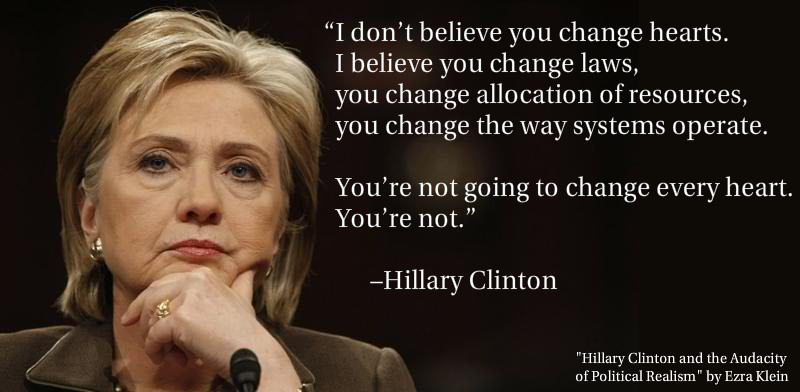
The “new liberal economics” is the key to understanding Hillary Clinton’s policies – Vox

[Well worth reading. -egg]

The Great Recession and its aftermath shattered the policy consensus on economics. What would come next? It’s taken a while, but we’re witnessing the emergence of an important new vision.

Before the crash, complacent Democrats, whatever their disagreements with their Republican peers, tended to agree with them that the economy was largely self-correcting. The Federal Reserve possessed the tools to nudge the economy to full employment, they thought. What’s more, government programs, while sometimes a necessary evil, were likely to be an inefficient drag compared with the private market. Inequality was something to worry about, sure, but hardly a crisis, and policies were correspondingly timid and market-focused.

But there’s been a quiet revolution in thinking about economic issues — at least on the left. Call the developing consensus the “new liberal economics.” Emerging from a wide range of academic research, popular writing, and activist energy, it reflects an economic liberalism that is both more comprehensive and self-confident than what was produced during the era of conservative dominance. Yet it’s not a nostalgic throwback but a forward-looking set of ideas and policies building out of the failures of the old paradigm.

Source: The “new liberal economics” is the key to understanding Hillary Clinton’s policies – Vox