IN OBAMA WE TRUST | Advocate.com
http://www.advocate.com/print-issue/current-issue/2012/07/06/obama-we-trust
(via Instapaper)
IN OBAMA WE TRUST | Advocate.com
http://www.advocate.com/print-issue/current-issue/2012/07/06/obama-we-trust
(via Instapaper)
[Jonathan Franzen meditates on “Peanuts.” -egg]
Personal History: The Comfort Zone : The New Yorker
http://www.newyorker.com/archive/2004/11/29/041129fa_fact?currentPage=all
(via Instapaper)
Paper Bird Anatomy: 


I just posted about the paper birds and animals of Diana Beltran Herrera a few weeks ago, but these new bird anatomy sculptures made with cut paper and vinyl film deserve some special attention. See more over on Flickr.
[Please accept this pseudo-unicorn chaser after the Mozart letter. -egg]
Enormous Bubbles Photographed by Bjoern Ewers: 


You might remember Berlin-based photographer Bjoern Ewers for his role in art directing the Inside Instruments project for the Berlin Philharmonic that went viral a few months ago. His latest work involves a series of bubble photographs titled Orbital that capture the hypnotizing whorls of colorful soap film in contrast with a stark black background. If you’re interested in prints he has several over on Artflakes. (via behance)
[Wait, WHAT? -egg]
When he wasn’t busy composing some of the most beautiful music ever to seduce the human ear, Wolfgang Amadeus Mozart could often be found writing shockingly crude letters to his family. The fine example below (translated by Robert Spaethling) was penned to Mozart’s 19-year-old cousin and possible love interest, Marianne — also known as “Betsie” (“little cousin”) — in November of 1777, at which point the poop-loving musical genius was 21 years of age.
If you’re easily offended, please do not read any further.
Note: The term “spuni cuni fait” was used in many of Mozart’s letters. Its meaning is unknown.
(Source: Mozart’s Letters, Mozart’s Life; Image: Mozart, via Wikipedia.)
Mannheim, 5 November, 1777
Dearest cozz buzz!
I have received reprieved your highly esteemed writing biting, and I have noted doted that my uncle garfuncle, my aunt slant, and you too, are all well mell. We, too, thank god, are in good fettle kettle. Today I got a letter setter from my Papa Haha safely into my paws claws. I hope you too have gotten rotten my note quote that I wrote to you from Mannheim. So much the better, better the much so! But now for some thing more sensuble.
So sorry to hear that Herr Abbate Salate has had another stroke choke. But I hope with the help of God fraud the consequences will not be dire mire. You are writing fighting that you keep your criminal promise which you gave me before my departure from Augspurg, and will do it soon moon. Well, I will most likely find that regretable. You write further, indeed you let it all out, you expose yourself, you indicate to me, you bring me the news, you announce onto me, you state in broad daylight, you demand, you desire, you wish you want, you like, you command that I, too, should send you my Portrait. Eh bien, I shall mail fail it for sure. Oui, by the love of my skin, I shit on your nose, so it runs down your chin.
apropós. do you also have the spuni cuni fait?—what?—whether you still love me?—I believe it! so much the better, better the much so! Yes, that’s the way of the world, I’m told, one has the purse, the other has the gold; whom do you side with?—with me, n’est-ce pas?—I believe it! Now things are even worse, apropós.
Wouldn’t you like to visit Herr Gold-smith again?—but what for?—what?—nothing!—just to inquire, I guess, about the Spuni Cuni fait, nothing else, nothing else?—well, well, all right. Long live all those who, who—who—who—how does it go on?—I now wish you a good night, shit in your bed with all your might, sleep with peace on your mind, and try to kiss your own behind; I now go off to never-never land and sleep as much as I can stand. Tomorrow we’ll speak freak sensubly with each other. Things I must you tell a lot of, believe it you hardly can, but hear tomorrow it already will you, be well in the meantime. Oh my ass burns like fire! what on earth is the meaning of this!—maybe muck wants to come out? yes, yes, muck, I know you, see you, taste you—and—what’s this—is it possible? Ye Gods!—Oh ear of mine, are you deceiving me?—No, it’s true—what a long and melancholic sound!—today is the write I fifth this letter. Yesterday I talked with the stern Frau Churfustin, and tomorrow, on the 6th, I will give a performance in her chambers, as the Furstin-Chur said to me herself. Now for something real sensuble!
A letter or letters addressed to me will come into your hands, and I must beg of you—where?—well a fox is no hare—yes there!—Now, where was I?—oh yes, now, I remember: letters, letters will come—but what kind of letters?—well now, letters for me, of course, I want to make sure that you send these to me; I will let you know where I’ll be going from Mannheim. Now, Numero 2: I’m asking you, why not?—I’m asking you, dearest numbskull, why not?—if you are writing anyway to Madame Tavernier in Munich, please include regards from me to the Mademoiselles Freysinger, why not?—Curious! why not?—and to the Younger, I mean Frauline Josepha, tell her I’ll send my sincere apologies, why not?—why should I not apologize?—Curious!—I don’t know why not?—I want to apologize that I haven’t yet sent her the sonata that I promised, but I will send it as soon as possible, why not?—what—why not?—why shouldn’t I send it?—why should I not transmit it?—why not?—Curious! I wouldn’t know why not?—well, then you’ll do me this favor;—why not?—why shouldn’t you do this for me?—why not?, it’s so strange! After all, I’ll do it to you too, if you want me to, why not?—why shouldn’t I do it to you?—curious! why not?—I wouldn’t know why not?—and don’t forget to send my Regards to the Papa and Mama of the 2 young ladies, for it is terrible to be letting and forgetting one’s father and mother. Later, when the sonata is finished,—I will send you the same, and a letter to boot; and you will be so kind as to forward the same to Munich.
And now I must close and that makes me morose. Dear Herr Uncle, shall we go quickly to the Holy Cross Covent and see whether anybody is still up?—we won’t stay long, just ring the bell, that’s all. Now I must relate to you a sad story that happened just this minute. As I am in the middle of my best writing, I hear a noise in the street. I stop writing—get up, go to the window—and—the noise is gone—I sit down again, start writing once more—I have barely written ten words when I hear the noise again—I rise—but as I rise, I can still hear something but very faint—it smells like something burning—wherever I go it stinks, when I look out the window, the smell goes away, when I turn my head back to the room, the smell comes back—finally My Mama says to me: I bet you let one go?—I don’t think so, Mama. yes, yes, I’m quite certain, I put it to the test, stick my finger in my ass, then put it to my nose, and—there is the proof! Mama was right!
Now farwell, I kiss you 10000 times and I remain as always your
Old young Sauschwanz
Wolfgang Amadé Rosenkranz
From us two Travelers a thousand
Regards to my uncle and aunt.
To every good friend I send
My greet feet; addio nitwit.
Love true true true until the grave,
If I live that long and do behave.
RSS Feed proudly sponsored by TinyLetter, a simple newsletter service for people with something to say.
Rand and Ron Paul denounce net neutrality and the public domain:
Rand and Ron Paul have penned an Internet Freedom manifesto that is pretty terrible. It pans the idea of net neutrality, arguing that the phone companies who receive gigantic government handouts in the form of cheap (or free) rights of ways and hold natural monopolies over our connectivity should be able to use that government largesse to run a protection racket in which any website that doesn’t pay for “premium carriage” will be slowed down when you or I try to visit them. They also denounce the public domain as a collectivist plot, and argue that government monopolies over knowledge should be extended, and that tax-dollars should be used to enforce them. TechDirt’s Mike Masnick has some choice words for the Pauls:
To them, any support of a neutral internet must be about “coercive state actions” and “collective rule” over “privately owned broadband high-speed infrastructure.” This makes me curious if the Pauls spoke out against the billions and billions in subsidies and rights of way grants that the government provided the telcos and cable providers to build their networks. Once again, I am against regulating net neutrality — because it’s obvious that the telcos will control that process and the regulations will favor them against the public — but pretending that broadband infrastructure is really “privately owned” when so much of it involved tax-payer-funded subsidies and rights of way is being in denial.
Then there’s the following, where they claim that these evil “collectivists” want to limit “private property rights on the internet” and are saying that “what is considered to be in the public domain should be greatly expanded.” Considering the Pauls were both instrumental in the fight against SOPA and PIPA, you would think that the two of them understood how copyright law is massively abused and how beneficial the public domain is. But apparently not. To them it’s all part of this “collectivist” plot. Earth to the Pauls: copyright is a massive government-granted monopoly privilege. That’s the kind of thing we thought you were against, not for. In this document, you seem to be arguing for one of the largest programs in the world of a centralized government handing out private monopoly privileges.
Ron And Rand Paul: Net Neutrality And The Public Domain Are Really Evil Collectivist Plots
“A conversation with my 12 year old self” (video):
[Video Link] An amazing video by Jeremiah McDonald. In this piece, he digs up a tape he recorded as a child 20 years ago, and has a conversation with the 12-year-old version of himself who once intoned to the video camera, “I think I’d like to talk to myself in the future.” (Thanks, Joe Sabia.)
It’s no coincidence that Higgs Boson looks like a pile of dry spaghetti: 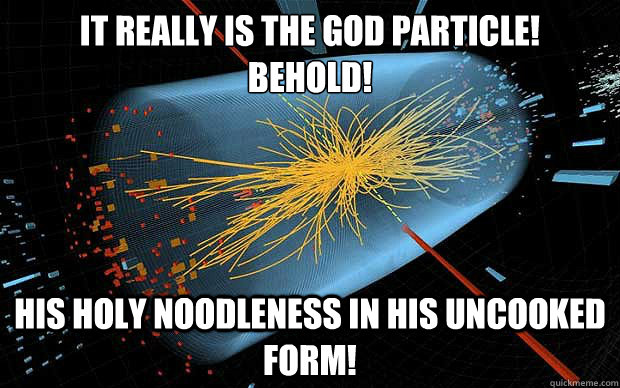
In light of recent images released by CERN, reader Snark^ reports that the Higgs Boson particle has been given a new nickname by Redditors. Behold: The FSM Particle.
RAMEN!
On the off chance that you did not spend the 4th of July glued to your computer, you should be aware by now that the Higgs Boson particle might have been found. Maybe. Or, rather, at least one of the Higgs Boson particles might have been found. It’s confusing. If you want some help cutting through the hype, I recommend that you check out the great links in our round-up of Higgs Boson news and analysis.
[Much better choreography/movement design than most other installations of this type — tragically, a lot of the ones I’ve seen have been pretty boring. Still lots of room for improvement, I think. -egg]
Kinetic Rain: 1,216 Computationally Controlled Bronze Raindrops at Changi Airport in Singapore: 


Berlin firm ART+COM just completed this stunning new kinetic sculpture in Terminal 1 of Changi Airport in Singapore. Kinetic Rain consists of two sets of 608 suspended raindrops made from lightweight aluminum covered in copper which are raised and lowered in a 15-minute computationally designed choreography controlled from motors embedded in the ceiling. ART+COM created a similar though somewhat smaller piece for the BMW Museum in 2008. (via hungeree)
Local haterade: Authors say locavores do more harm than good | Grist
http://grist.org/locavore/local-haterade-authors-say-locavores-do-more-harm-than-good/
(via Instapaper)

