
Eric Sloane’s Weather Book
[Interesting. -egg]
Eric Sloane’s Weather Book: 
By means of insightful hand-drawn diagrams, Eric Sloan gives the best explanation I’ve ever seen of how weather works. Originally created to help sailors 50 years ago, it works for pilots, outdoor explorers, and anyone else dependent on a change of weather.
— KK
Eric Sloane’s Weather Book
Eric Sloane
2005, 96 pages
$10
Available from Amazon
Sample Excerpts: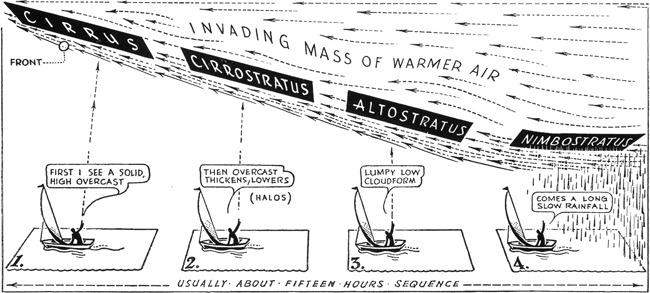
*

*

Article: Profiles: Secrets of Magus : The New Yorker
[Pretty awesome. -egg]
Profiles: Secrets of Magus : The New Yorker
http://www.newyorker.com/archive/1993/04/05/1993_04_05_054_TNY_CARDS_000362341?printable=true
(via Instapaper)
Forgot Algebra

How to Help Realign Someone’s World View

Babies driving robot wheelchairs (super cute video)
Babies driving robot wheelchairs (super cute video):
[Video Link]
Here’s an amazing feel-good video with which to end your week, via the National Science Foundation. The really awesome footage starts around a minute and a half in.
“James C. (Cole) Galloway, associate professor of physical therapy, and Sunil Agrawal, professor of mechanical engineering — have outfitted kid-size robots to provide mobility to children who are unable to fully explore the world on their own.”
The robotic assistance devices are designed to help infants whose mobility and independence is limited by conditions such as autism, spina bifida, muscular dystrophy, Down syndrome, and cerebral palsy.
I understand that these will be among the many exhibits on display at the USA Science Fest at the Washington, DC Convention Center on Sat., April 28th. Babies probably not included.
Victorian change packets: little envelopes for your small change
Victorian change packets: little envelopes for your small change: 

Julie L. Mellby posts on Princeton University Library’s Graphic Arts Collection blog about the Victorian “Change Packet,” a little paper envelope that Victorian shopkeepers used to present customers’ change (as Abi points out on Making Light, this embodies some odd assumptions, like shopkeepers never shortchanging their customers, and customers not wanting to spend their change at the next shop). These are beautiful items, and have a fascinating history. From The Encyclopedia of Ephemera: a Guide to the Fragmentary Documents of Everyday Life for the Collector, Curator, and Historian (Michael Twyman, Maurice Rickards):
“Among the refinements of middle-class Victorian shopping was the giving of change not directly from hand to hand but in paper packets. Chamber’s Edinburgh Journal in a review of London shops and shopping (15 October 1853), makes passing note of the custom. A customer seeking to buy a pair of kid gloves ‘is met at the door by a master of the ceremonies, who escorts him to the precise spot where what he seeks awaits him … He walks over rich carpets, in which his feet sink as though upon a meadow-sward; and he may contemplate his portrait at full length in half-a-dozen mirrors, while that pair of gentlemen’s kids at 2s 10 ½ d is being swaddled in tissue-paper, and that remnant of change in the vulgar metal of which coal-scuttles are made … is being decently interred in a sort of vellum sarcophagus ere it is presented to his acceptance’.”“The envelope, known as a ‘change packet,’ measured some 60 mm (2 ½ in) square and was printed with the legend ‘The change, with thanks’, often in a decorative roundel or other device. Printing was generally in a single colour; sometimes the design appeared as a white, embossed image on a coloured background.”
“The packets were supplied to the shopkeeper either as a stock design in which there was no trade message, or printed specially to order with name, address, and designation presented as a form of miniature trade card. Additionally, the shopkeeper might be supplied with the packets at much reduced rates, if not free of charge, by the new breed of national advertisers who used the printing space on the packet for their own message. Typical of these were Huntley & Palmers, biscuit manufacturers, whose change packets were widely used. Their Royal Appointment design appears in two packet sizes and a variety of colours.”

(via Making Light)
Building covered in old clothes
Building covered in old clothes: 
The Guardian‘s Deborah Orr is probably right that the Marks and Spencer “shwopping” initiative is “an ugly word for a dubious enterprise”, but I am rather taken with this promotion for the program. M&S is encouraging shoppers to “shwop” — swap their old clothes for discount vouchers when they buy new clothes at M&S, with the old clothes going to charity — and to promote the affair, they covered this large Truman Brewery warehouse building off Brick Lane with used clothes, to great effect.
Article: Lester Bangs on "Astral Weeks"
[Lester Bangs makes me want to walk around at night with Van Morrison on my headphones. -egg]
Lester Bangs on “Astral Weeks”
https://personal.cis.strath.ac.uk/~murray/astral.html
(via Instapaper)