
Tiny Homes

Tiny Homes:

This book will convince you to build your own house. The key is to make it small. A really small house costs less, liberates time, and encourages you to spend that time making the details personal. Because everything is scaled down, the space is much more customized. The result is a home that grows out of your life.

Tiny houses are the norm for most people in the world, but have been out of fashion in the US for many decades. Recently some Americans are rediscovering the joys of very tiny homes for several reasons: hard economic times, a reaction against modern excess, and a realization that a digital world does not require a lot of space. There are now a handful of blogs and a whole shelfful of books about tiny homes. Mostly good stuff.

This new book is the best of those guides and eclipses the previously recommended The Tiny Book of Tiny Houses. Lloyd Kahn has built several of his own small homes, and has edited a number of great books celebrating owner-built shelters, including the previously reviewed Home Work. Here he focuses on tiny homes, which he defines as shelters 500 square feet or less. Some are on wheels, a few float, some are pre-fab, but most are handmade shelters placed in odd corners in cities, suburbs and the country. Their variety is stunning. This large book erupts with a cornucopia of 1,300 photos featuring 150 different tiny homes, showing you how they were built, giving resources and helpful tips of their construction, supplying design solutions and inspiration for others, but also conveying WHY they were built. Tiny though they are, they are much more than mere shelter.

What I love most about this book — as a tool — is the way it explodes the possibilities of what a tiny house can be, and how every page conveys the important message that the challenge in building such a tiny structure is not the material, which is almost trivial by definition, but the immaterial. A tiny home is a matter of gumption, resourcefulness and imagination. This book, like all Lloyd Kahn’s work, cultivates those virtues.

You leave the book realizing, knowing for sure, that you, yes you, can build a tiny house. And should.

— KK

Tiny Homes: Simple Shelter

Lloyd Kahn

2012, 228 pages

$15

Available from Amazon

Sample Excerpts:

Sample excerpts:

tinyhome1.jpeg

The theme of our eco-resort has always been Adirondack Style, which translates to “built with time and no money.” Each year we renew our contract with the state to harvest “dead and down trees.” It’s like building structures in the middle of Mother Nature’s lumberyard.

*

[This 97 sq. ft. house] was originally a pump house built over a well in 1900. At some point in the ’70s it was converted to a chicken coop. A couple of years ago I converted it to a stationary yacht. The design was inspired by living on a small sailboat in Alaska. It’s superior to a sailboat in that it needs less maintenance, is unlikely to sink, has lots of windows, and is surrounded by a garden so you don’t need to row ashore. It’s inferior to a sailboat in that it can’t sail anywhere.

*
tinyhome2.jpeg

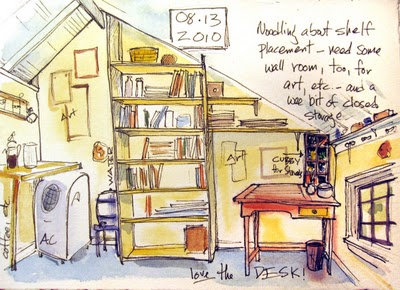
I did a quick sketch of what I needed.

*

tinyhome3.jpeg

The key to designing my happy home was designing a happy life, and the key to that lay not so much in deciding what I needed but in recognizing all the things I could do without.

*

tinyhome4.jpeg

It is not a building. It’s MY building.

*

tinyhome5.jpeg

The pentagonal floor is made from lumber milled on site. At center is a pentagon. On Mike’s birthday, October 29, a beam of light shines through a hole in a 5-pointed star in the door, and falls on the central pentagon!

RAW Week: Mindfucking Since 1976, by Gareth Branwyn

RAW Week: Mindfucking Since 1976, by Gareth Branwyn:

Illuminatus

Above: Gareth’s original copies of The Illuminatus Trilogy.

“It’s not true unless it makes you laugh, but you don’t understand it until it makes you weep.” — Illuminatus!

I first discovered Robert Anton Wilson when I was 18 years old. I’d just moved to a commune in the tobacco fields of central Virginia and was working for the magazine that the community published. Wilson and Bob Shea’s Illuminatus! trilogy had just been published and I sent off for a review copy on the magazine’s letterhead. I was shocked when Dell actually sent me the books. I had no idea what Illuminatus! was; I thought I was getting some free trash sci-fi to kill time down on the farm.

The first few chapters in and I knew I wasn’t reading sci-fi, not any kind I recognized, anyway. Reading the first book, The Eye in the Pyramid, then the second, The Golden Apple, and then the third, Leviathan, was like going on an extended acid trip, complete with that phasing delirium of humor and the absurd, flashes of diamond clarity and numerous a-ha moments, awkward sexual arousal, plenty of cartoonery, fear, paranoia, and maybe a little out-and-out terror. (It’s no coincidence these books are divided up into ten “Trips.”) There is so much to Illuminatus!, an almost fractal density, that you have to unhinge your mind (like a serpent would its jaw) to fit it all in. I read the trilogy, and then read it again. (When my late-wife and I hooked up, we read them out loud to each other, and after Bob died, I read them for a fourth time.)

There are few works of art or pieces of media that have altered my nervous system to the extent that Illuminatus! has. In 1976, I was this awkward, alienated Wiccan teen, a restless seeker. But I was also a science and space nerd. I could never reconcile these two and constantly switched between them, rejecting one for the other, at least for a time. But here was a world where these points of view were not mutually exclusive, a playfully plastic world where open curiosity, creativity, absurdity, and skepticism leavened all explorations, whether religious/mystical/artistic or scientific. It was Robert Anton Wilson who turned me onto the concept of “hilaritas” (what he described as being “profoundly good natured”). These books (and all of RAW’s oeuvre) are steeped in that spirit.

Illuminatus!, and all of the Robert Anton Wilson books that I read after that (which is all of them), have formed an amazingly steady through-line in my life. I’ve gone through many intense changes since that 18 year old kid scammed free reading material, and my belief systems (or “BS” as RAW called them) have oscillated wildly, but most of my takeaways from Wilson have remained. His basic approach of being “open to anything, skeptical of everything” is how I’ve tried to live my life. This allowed me to finally embrace both parts of myself, the part that wanted to be open to magick and spirit and the part of me that needs extraordinary evidence for extraordinary claims.

In recent past, I’d somewhat fallen out of touch with RAW’s unique brand of “guerrilla ontology” until a few years before he died. Some friends were on their honeymoon, traveling through the deserts of Utah. They found the 5-volume set of audio interviews that Bob had done called Robert Anton Wilson Explains Everything: Or Old Bob Exposes His Ignorance, in the bargain bin of a truck stop. They aren’t particularly into this sort of thing, but more based on my interest, they bought the set. They listened to it on their honeymoon and enjoyed it so much, they bought me a copy. I now listen to it regularly and can’t recommend it highly enough.

At one point in Robert Anton Wilson Explains Everything, the interviewer asks Bob why he’s so into conspiracy theories. He’d spent the better part of his life studying them, writing about them, but he doesn’t seem to actually believe any of them. So, why the intense interest? Bob thinks about it for a moment and replies: “It keeps the mind supple.”

Thank you, Mr. Wilson, for pulling an uptight, overthinking teen out of his constrictive reality tunnels and for a lifetime of “keeping the mind supple.”

Bonus Bob!: There are many threads and themes shot through Illuminatus!: Puzzles, parodies, bad puns, conspiracy theories, synchronicities, Burroughsian cut-ups, libertarian politics, occultism, sex, drugs, and rock n’ roll. One of these themes is pranking, part of what Wilson and Shea dubbed “Operation Mindfuck” (or OM); what they describe as the only serious conspiracy in the book (of which the book is the principle manifestation). OM is the art of confusing consensus reality with plenty of pranks, misinformation, and mindfucks. In the appendices, a rubber stamp is described that reads “See Mental Health Records.” On any bills, junk, or other mail that one of the Discordian characters didn’t like, he’d use this stamp on the envelope and return to sender. After reading about this, I had a stamp made up that read: “This is Not Art” (a statement from the Fluxus movement). For years, I stamped this on tax returns and business envelopes, on the backs of endorsed checks, on much of my daily correspondence. I loved imagining what the various worker bees who processed my paperwork made of this puzzling statement.

So, give the world’s sad sonambulism a wakeup call. Put some OM (whether “trivial or colossal”) in your day. Bob would have wanted it that way.

Fnord


World building 301: some projections

Sent to you via Google Reader

World building 301: some projections

Right now, over at the venerable discussion board known as the WELL, Bruce Sterling and Jon Lebkowsky and having their regular annual State of the World pow-wow, this time for 2012.

I always find these fascinating, because Chairman Bruce is the pre-eminent thought leader of modern near-future SF.

He’s been one jump ahead of the pack ever since the early 1980s (when I avidly subscribed to his pseudonymous crit zine Cheap Truth, the house self-criticism session of the early cyberpunks), then the mid-1980s when he basically invented the New Space Opera and moved on before anyone else had time to notice, and then the early 90s when he got the implications of the internet and climate catastrophe in Heavy Weather … seriously, if I’m ever at a loss to know what the big near-term global issues are, I look for his footsteps and follow them. (It’s no accident that a few years ago he seemed to lose interest in dying media and high-tech environmentalism and went after industrial design and 3D printers.)

Anyway.

I’m going to use some of his mojo as a jumping off point for asking: what is the world going to look like in 2032? And in 2092?

It’s an important question. I expect to be around in 2032, albeit somewhat more creaky (I’ll be 68) — the state of the world in 2032 is a matter of personal interest. By 2092 … well, if I’m still alive in 2092 there will have been medical breakthroughs, because I’d be 128 years old, and that exceeds the current boundary with which human life expectancy converges (which is roughly 121-122). My grandfather died a couple of months short of his 70th birthday; my father is still going strong at 87: a straight line extrapolation would peg me at making it past 104, although I don’t think I’m as healthy as dad. So it’s a matter of rather more theoretical interest to me, but nevertheless worth worrying about just in case the next 20-80 years bring us some massive breakthroughs in life prolongation.

What do I predict for 2032?

Climate: the current remaining question marks over climate change will have been answered, and the answers won’t be anything pleasant. Climate change denialism will probably be about as respectable as Lysenkoism is today — an intellectually corrupt pseudo-science emerging at the behest of a bankrupt ideology. Chunks of the world will be suffering heat stress with damaging effects on agriculture (notably Australia, where imported European-style agricultural prac…

Untitled flower scan, Katinka Matson

Untitled flower scan, Katinka Matson:

An untitled work by Katinka Matson, via John Brockman and EDGE.org. The artist’s site is here, and you can view a larger-size image here (fun to gaze at on an iPad, I think).

Update: Boing Boing reader Jennifer Forman Orth, Ph.D., who is an Invasive Plant Ecologist, says, “That’s actually a scan of the seedheads of a Clematis vine. So not a flower, not anymore – already pollinated and gone to fruit. But a small technicality for that beautiful image.”

Macoto Murayama’s incredible digital flower diagrams

Macoto Murayama’s incredible digital flower diagrams: Macotooooo

Macoto Murayama’s exquisite “Inorganic Herbarium” diagrams will be on display at Frantic Gallery’s booth in the Art Stage Singapore Art Fair next weekend, January 12-15. I first posted about his work back in 2009 and its evolution is nothing short of breathtaking.

 Wp-Content Uploads 2012 01 Murayamamamamama

This time we present exclusively large scale Botanical Diagrams by Murayama with a vast explanatory material on both botanical and technical context of his digital flowers. We will also show how the artist creates his works, beginning from vivisection of a real flower, photography, sketches and then software for 3-Dimensional drawings. For the first time, the original flowers used for the Botanical Diagrams will also be shown inside transparent vessels filled with formaldehyde.

Macoto Murayama: Botanical Diagrams

Nathan Richard Phelps’s oil pen marvels

[Yum. -egg]

Nathan Richard Phelps’s oil pen marvels:

 Site Home Files E61-Filtered

Tompkins Window

One evening this week, my wife and I were walking on Market Street in San Francisco when we were awestruck by the painting at left leaning in the window of the E6 Gallery. The artist, Nathan Richard Phelps, was inside hanging his work for a solo show opening this Friday. He must have noticed our stunned expressions because he opened the door to chat for a bit. A delightful guy, he explained that this huge (7 foot tall!) oil pen painting, titled “Tompkins Window,” was commissioned by a couple living in a Manhattan apartment. Makes sense, as the piece has an architectural/city planning vibe to it but also evokes memories of early computer drawing programs that, as my wife said, might run on a 1980s Atari. Several of Phelps’s paintings are in this angular style while others are all about organic curved forms in almost op art patterns. They are all marvelous.

Nathan Richard Phelps

E6 Gallery


Year-end mix 2011

[2011 mix from someone whose taste I really love and respect. -egg]

Year-end mix 2011:

Well, you probably thought I was never coming back, eh?

For awhile, I thought maybe I wouldn’t have the time to either, but then I told myself I’d set a hard limit on the amount of time I could spend working on a mix and end up finishing it in half that time. Working through the transitions in my head prior to sitting down at the computer helped a bit, and while it isn’t nearly as involved as the 2009 mix that I did, I feel pretty happy with how it turned out.

The artwork is at right, and you can download it by clicking on the artwork or this link right here.

Names of artists involved is on the artwork itself, but here’s the full tracklisting. It runs just over an hour, for those keeping track at home.

  • 00:00 | Colin Stetson – “A Dream Of Water” (from New History of Warfare Vol. 2: Judges)
  • 03:04 | Bill Callahan – “America!” (from Apocalypse)
  • 08:28 | The Drums – “Days” (from Portamento)
  • 12:53 | Panda Bear – “You Can Count On Me” (from Tomboy)
  • 15:20 | Sandro Perri – “Love & Light” (from Impossible Spaces)
  • 18:55 | Rustie – “Surph” (from Glass Swords)
  • 22:55 | Battles – “Wall Street” (from Gloss Drop)
  • 27:35 | Sepalcure – “Eternally Yrs” (from Sepalcure)
  • 32:20 | The Weeknd – “Initiation” (from Echoes of Silence)
  • 36:24 | Machinedrum – “U Don’t Survive” (from Room(s))
  • 41:00 | Robag Wruhme – “Pnom Gobal” (from Thora Vukk)
  • 46:15 | Andy Stott – “Posers” (from We Stay Together)
  • 50:52 | Tim Hecker – “In The Fog III” (from Ravedeath, 1972)
  • 54:52 | Leyland Kirby – “They Are All Dead, There Are No Skip At All” (from Eager to Tear Apart The Stars)

Now, I just need to get motivated to post some sort of year-end list in the next couple weeks. All of the artists featured above are on it (as well as some others). There’s a hint, I guess.