Fish mimics mimic octopus

Fish mimics mimic octopus:

This is a great find by Not Exactly Rocket Science‘s Ed Yong. A tourist and a couple of researchers from the California Academy of Sciences have documented an instance of Pacific-dwelling jawfish hiding from predators by blending into the stripes of well-known camouflage guru, the mimic octopus.

This relationship is probably a rare occurrence. The black-marble jawfish is found throughout the Pacific from Japan to Australia, while the mimic octopus only hangs around Indonesia and Malaysia. For most of its range, the jawfish has no octopuses to hide against. Instead, Ross and Rocha think that this particular fish is engaging in “opportunistic mimicry”, taking advantage of a rare chance to share in an octopus’s protection.

Video Link

Thanks, Atvaark!


Hamster-powered sub

[I’m so all about the investigation of post-animalism as science and art. See also one of my favorite artworks of all time, augmented beta fish. -egg]

Hamster-powered sub:

Two (unnamed?) Ocean Engineering students created a “hamster-powered submarine” from “materials derived from common household objects” that connected a hamster wheel in a sealed, air-supplied vessel to a propeller, allowing hamsters to take themselves on aquatic jaunts. They documented the build in some detail, and supplied a video of the maiden voyage. One of the design requirements was “the life and well being of the hamster must not be compromised in any way.”

HPS Hamstar: the Hamster Powered Submarine
(via DVICE)


HOWTO make a custom snowglobe of your house

HOWTO make a custom snowglobe of your house:

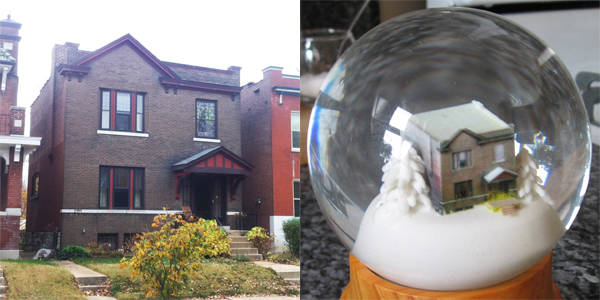
A clever fellow called Qarl figured out how to make a custom snowglobe of his family’s house as a surprise gift for his wife. He auto-modelled it in Google Sketchup, cleaned it up some, added a snowy hill, sent the model to a 3D printing company, and popped it in a snowglobe kit. Voila!

1) order a custom snowglobe kit. ebay has a bunch to choose from. try to find one that tells you its exact dimensions so you can size your model before the globe arrives in the mail.

2) take pictures of your house. you probably want at least eight circling the perimeter. more can’t hurt.

i also grabbed a top-down view of my house from google’s satellite maps. it’s very low-res, but the house is going to be tiny, so it works out.

3) build a cg model of your house.

i tried a handful of the “automatic” systems to build models. microsoft’s photosynth, autodesk’s 123D catch, a couple lesser known programs. none of them worked well enough to produce a final model – they did well for 75% of the model, but then horribly mutilated the last 25%.

in the end i went with google’s sketchup – its photo match tools are great for building models from photos of buildings.

the weather outside is frightful

(via Super Punch)


3D printing in ice

3D printing in ice:

Katharine Gammon writes in Wired about the work of McGill University researcher Pieter Sijpkes and colleagues, who have produced an experimental 3D printer that produces ice-sculptures. The researchers give current applications as a cheap alternative to printing in plastic goop (thanks to patents that will soon expire, the plastic powder used in high-end 3D printers costs more than filet mignon) and for “ice tourism.”

He and his team have printed a statue, an egg carton, a martini glass, and molds that melt conveniently away. Why ice? Well, it’s cheap and readily available, and low-cost ice models could help inventors design products more quickly. The challenge of printing with ice, besides the very cold temps necessary for the process, was building a machine that’s up to the task. Here’s how Sijpkes did it.

Building a 3-D Printer for Supercool Ice Objects


Dazzle makeup and hairstyles to confuse facial recognition algorithms

Sent to you via Google Reader

Dazzle makeup and hairstyles to confuse facial recognition algorithms

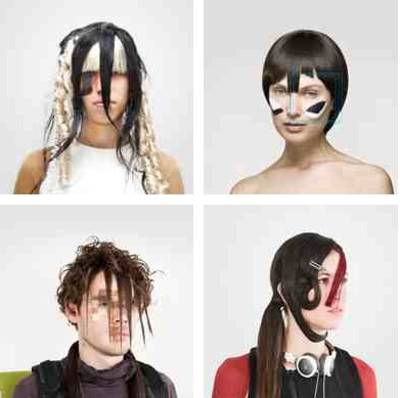
CV Dazzle is a systematic approach to creating “dazzle” makeup and hair effects that fool computer vision systems. For example, you could change the symmetry of your face by painting a lightning bolt across it, causing all computer vision systems to mistakenly identify you as David Bowie.

There is a strong emphasis towards radical-neutrality. The designs used in the first several looks are inspired by both tribal paint and high-fashion aeshetics from the club scene in London. In fact, photos from both were incorporated into the testing algorithms. Surprisingly, many of the more eccentric looks did not fool the face detection algorithms.

To design the looks at left, software was developed that combines interactive drawing and genetic algorithms to detect vulnerabilities in the face detection process. By understanding how face-detection algorithms work, an anti-face can be constructed and used as a guide for creating makeup and hair-styling that foils the face detection process. As a result, your face becomes undetectable to machines yet retains some level of legibility to humans.

CV Dazzle

(via Make)


Searching for Africa’s living dinosaur

Searching for Africa’s living dinosaur:

 Storage Picture-2-Baby

For hundreds of years, Westerners have heard tales from pygmies living in the Congo river basin of a living dinosaur called the Mokèlé-mbèmbé, the “one who stops the flow of rivers.” The BBC World Service talks to several explorers on the search for this beast that apparently may resemble a sauropod, elephant, rhinoceros, or perhaps something more akin to a “spirit” than a real animal. From BBC News (image from, er, Baby):

Paul Ohlin, a community development worker who spent more than 10 years living with the Bayaka in Congo and the Central African Republic, just to the north, says the people who live in the area are in no doubt about the creature’s existence.

“When people are sitting around the campfire talking, they talk about the Mokele-mbembe – it’s something that’s a reality in everyday life,” he says.

At the same time he emphasizes their “spiritual connection” and “mystical relationship” with it.

“The way they see the world is a little different to the way you and I see it,” says Paul.

But their eyewitness reports still need to be taken seriously, in his view.

The hunt for Mokele-mbembe: Congo’s Loch Ness Monster(via The Anomalist)


Why we shouldn’t let Google (or anyone else) claim their private services are public spaces

Why we shouldn’t let Google (or anyone else) claim their private services are public spaces:


Photo: Shutterstock.

At Google+, Tom Anderson argues that Google’s “don’t be offensive” policy is good precisely because Google+ is a public space.

On the contrary, it’s the insistence that Plus is a public space that makes such policies troublesome, rather than mere quality control.

Conduct rules are, by and large, a good thing for any private venue that wants to avoid turning into a cesspool. They’re desirable in all sorts of other private contexts, too; a good example is a newspaper that doesn’t want to publish every deranged Letter to the Editor that comes in, or a quiet restaurant that needs to turf out an abusive patron. Guests in your home can’t demand the right to say anything they like in your lounge.

Likewise, deleting offensive content would be just fine if Google stopped marketing Plus as a public venue where you (rather than Google) can express your “real life” personal identity.

No-one—not MG Siegler (whose naughty avatar precipitated this mini-fuss) or anyone else—has the right to be published by Google. So everything Tom says about social networks applying policies is just fine—so long as they don’t claim to be public spaces.

By doing this, Google’s encouraging a kind of double-think. It’s private in all the respects that serve Google’s business interests and protect it from liability and risk, but public in all the respects that make us want to use it. But in trying to have its cake and eat it, Google ends up staking an implicit claim to quality-control over what people think is public speech.

It’s telling that Tom offers shoppings malls as an example of a “public” place similar to Google+. In fact, almost all malls are entirely private settings, which is why they have the right to boot out people wearing offensive shirts. Just because lots of people are somewhere, that does not make it public.

Google might not be evil, but there are plenty of evil people who stand to benefit from the blurring of public and private life; and who’d love to take advantage of the systems it’s building to maintain a close eye on all of it.

Does it really need to be explained why all this is bad? The courts have spent centuries determining reasonable limits of free speech in public settings: we don’t need private corporations absorbing the public sphere, providing governments and themselves easy mechanisms to marginalize anyone unwilling or unable to play nice inside the walled gardens.

The U.S. Constitution defines a right to free speech for many reasons, not least because it’s never just about the proverbial middle finger. The rationale of public decency and safety can be extended to silence critics, as well as coax decency out of scandalous, unshaven thugs like MG Siegler.

Don’t let private companies represent themselves as public spaces. ‘Cause they ain’t.


LOW INCOME TOMORROWLAND SEEKS STUDIO ASSISTANT

[Awesome job or awesomest job? From DJ/Rupture. -egg]

Sent to you via Google Reader

LOW INCOME TOMORROWLAND SEEKS STUDIO ASSISTANT

cildo morales zero dollar low

Are you sharp-minded with catholic tastes? Un(der)employed? Adderal-addled and wanting a plurilinguistic change? Talk to me.

I’m starting a project studio called LOW INCOME TOMORROWLAND and am looking for a studio assistant. Think: deep research. Think: Sufi Plug Ins. Think: there’s no way the future will be boring.

Details here.